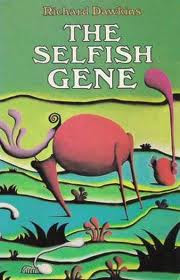
THE SELFISH GENE by Richard Dawkins (30th Anniversary Edition)

This book made a big splash when it was first published in the 1970s, and it is now in its 3rd edition.

Essentially, the book argues that evolution does not work on a family, group, or species level, but on the level of the gene.

Humanitarian feeling, by this measure, is not occasioned by a desire on the part of humans for humanity to survive, and it is certainly not (perish the thought) occasioned by some higher, non-biological feeling we might have (what! something non-biological, never!).

Dawkins takes us back to the primordial soup in which loose bits and pieces slowly formed molecules. The molecules which survived, were the molecules which were successful. They formed sacs to keep themselves safe, or learnt how to push chemicals away, or whatever. And slowly they developed into full organisms. However, the driver is still those early small organisms, which are now recognisable as DNA. So, for example, the DNA for two legs survived because giving a creatre two legs made that creature more likely to survive and thus produce DNA. We are, in Dawkins view, just robots created by our DNA to carry our DNA around and keep it safe.

I actually find this quite a believable theory. Though, why should we care what I think? I don’t know squat about biology.

He includes a very interesting section on how the basic rule of most religions – do as you would be done by – might have been shaped by evolution. More here if you’re interested.

Dawkins can’t bear religious fundamentalism, which is I find hilarious, because he is such a biological fundamentalist. He is so insistent on the whole nothing-beyond-biology argument, it gets a bit embarrassing. I think insisting loudly that there is not a god is just as silly as insisting loudly that there is one. You can really only weigh in on that one when you’re dead.

It does explain family feeling in an interesting way: in essence, his argument is that we protect members of our family because they share so much of our DNA. But where I struggled a bit was: we share like 99%of our genes with chimps. Surely therefore we should be conditioned to work for their survival too? But this is clearly not the case.

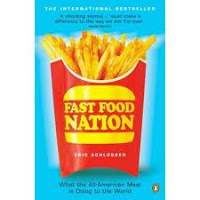
FAST FOOD NATION by Eric Schlosser


After all that 19th century morality I thought it was time for 20th century immorality. FAST FOOD NATION provides that in spades. Spades of offal, eyeballs, fat, salt, animal cruelty and poor working conditions for illegal immigrants.

This book is about the way in which fast food has shaped global culture. He begins by discussing the genesis of fast food as we know it. Apparently, it arose in Southern California, a place built very much around the motor car. There were lots of places selling burgers and so on, but it was all cooked from scratch by experienced cooks, with waitresses on hand. Then the McDonald’s brothers – who were sick of their teenage clientele, apparently, who came mostly for the young pretty waitresses – came up with a new system, based on the production line concept. They cut their menu to only those things that could be eaten without a plate or cultery, and simplifed the food preparation process so that no experience was necessary – each worker just did one simple part of preparation, so experienced short order cooks were no longer necessary. They were thus able to massively cut prices, and business boomed. Apparently this was the first time working class people could afford to eat in a ‘restaurant.’ Other people copied, and the idea spread. The McDonalds – now this is heartening – after they got really really rich, weren’t interested in getting any richer. So they weren’t looking to expand. But this other guy, Ray Kroc, convinced them to let him franchise for them. And that’s the real birth of the chain. He always said he wasn’t in the food business, but in show business – interesting, no? Anyway, he always resented doing what he perceived as all the work, and was eventually delighted to buy them out, and in the end force the closure of their last restaurant (now called M) by opening a McDonald’s up the road.

Interestingly, practically every big fast food chain was started by a high school drop out.

The book also talked about how fast food restaurants market primarily to children, especially toddlers. 25% of Americans eat fast food in any one day, and 90% of American children under 9 visit a McDonalds in any one month. Oh yes. It’s not good news. I in 8 Americans has actually worked for McDonalds at some point.

Also, something I never knew is that fast food in itself is made to be bland, as the flavour actually comes for added chemicals – just a few drops, that are carefully controlled. Most of the flavour in all fast food is made in New Jersey, apparently.

Obviously, the treatment of the animals is not great. But it’s actually getting better. However, the treatment of the people who work in meat packing is APPALING. That was really depressing. Lots of exploiting illegal immigrants etc. The treatment of the kids (the majority of workers are under 19) who work in the restaurants is not brilliant either. McDonalds works hard to fight unions, and sends in crack teams to stop any incipient unionizing. Not a single US restaurant is unionised. WOW.

One interesting thing was how much these big corporations, that drivel on about the free market, and competition, etc etc, are happy to take government handouts. Lots of franchises are begun with money from the fund meant to help small businesses. In fact, big corporations use it when they’re not sure an area can stand another Burger King or whatever, as they know the government will just take the loss. Also, they’ve worked hard to make sure franchisees have none of the normal consumer protections -eg, they corporations can cancel the contract at any time; they can limit who you can sell it too; they can make you use their suppliers, no matter what the cost, etc etc.

And yet, I have to tell you that all this talk about french fries made me want to eat french fires. What does this mean?

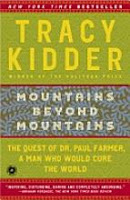
MOUNTAINS BEYOND MOUNTAINS by Tracy Kidder


This one was a true story about a man called Paul Farmer who has had a lot of success in improving public health for the poor. It all began when he went to Haiti during college, and was appalled. Impressively, bit by bit, he managed to set up an extremely good public health system in a very poor area in Haiti. His work spread to other countries, and he’s had a wide impact. Apparently the way in which TB was being treated globally was encouraging the development of MDR (multiple drug resistant TB) which is obviously very dangerous. The central problem in treating it was that the drugs were deemed too expensive, and managing patient lifestyles (food security, etc etc) too difficult. He managed to get the drugs made cheaper, and also entirely shift the paradigm for what was possible in monitoring patient lifestyles.

So all very impressive. He is really dedicated to the idea that you ought to work for the poor, because that’s a good in itself, a clear area of moral clarity. He doesn’t think you should work for money, or even for a feeling of personal efficacy (which was interesting, as I’d just been feeling jealous of just that aspect of his life!). In fact, he himself feels deeply guilty when not focused on working for the poor. I have often noticed that when Americans come to Africa they are amazed by the poverty. They can’t believe it is possible, or should be allowed. They just think it shouldn’t be possible, and is some kind of insult to the world. Which is maybe the right way to see it, but it’s also a very first world, naïve view. But whatever. He still saved thousands and thousands of peoples lives. You can’t argue with that.

Well maybe you can a little bit. It was an interesting book, but I had a couple of difficulties with it that made it a slightly uncomfortable read. For one thing, I’m not really sure I think that much money should be being spent on health. I’m not sure that there’s any point in just keeping people alive, basically through donations, without creating jobs, environmental sustainability, political stability etc. You shouldn’t just be pumping up population levels, because that will just make all the other problems worse, which will mean more issues for health, and thus more donations etc etc. So I’m not sure it’s actually the right priority. I know it sounds really cold, but if I was running a government, I’d spend much more money on education than on health. I think education starts to feed back and fix problems on its own, in a way improving health just doesn’t. Though then the books tells how one of Farmer’s clinics was bombed by the Shining Path guerillas, because they thought that these small improvements of the poor’s life just delayed the necessary revolution. I can’t deny I do sort of see the logic. So that made me feel a bit Pol Pot.

GULAG ARCHIPELAGO (Contd)


This book has taken me months to read. This is not because it is boring, but because it is so sad it is hard to keep going. It is sad like real life is sad, because the sadness has no rhyme or reason or moral. If you didn’t read my earlier post, GULAG ARCHIPELAGO tells the story of the death camps that existed in Stalinist Russia from the 1930s onwards, and is written by a man who survived them. Obviously, the state was not keeping good records of what was going on – indeed, they were trying to cover it up – and most free people did not know what the camps were like. Solzhenitsyn clearly strongly felt that all the people he met should not have died entirely unmourned and in vain, so he set to record as much of it as he could, based on the people he himself met, and those others met.

The cover has a quote from the Preface “For years I have with reluctant heart withheld from publication this already completed book: my obligations to those still living outweighed my obligation to the dead. But now that State Security has seized the book anyway, I have no alternative but to publish it immediately.” It got seized because a woman he entrusted part of the manuscript to broke down after A HUNDRED AND TWENTY HOURS of interrogation without sleep, and revealed its location, and the poor woman was so distressed by the betrayal that she killed herself.

What’s perhaps saddest about the book is the way in which he’s clearly writing about events that are so current. He gives lots of tips about how to survive prison – like practical stuff about surviving the thirst when they feed you only very salty fish and a half mug of water a day, and about how you must give away anything of value right away, as a man who has something to lose is a man who fears, and that’s lethal – really sort of awful grim advice – and it’s clear he’s doing this because many of the people reading will be going to prison themselves.

Guess how many people were in the Gulag at any time? Answers on a postcard. Oh, okay, I’ll just tell you. SIX TO TWELVE MILLION. And this is not prison, this is death camps. Often, you’d spend a month in a transport, with a hundred people in a railcar meant for twenty, and corpses thrown out at every stop (this is when you get the fish and water and nothing else), and when you get to the end of the line in Siberia, there is nothing there. Nothing at all. You are just going to build the camp right there. But it’s -30C, so you can’t dig into the ground, you just lie under tarpaulins in thin clothes (the guards steal all your warm clothes) and are sent to work everyday. And all you get to eat is fish, and just flour, that you wash down with SNOW. So obviously, almost everybody dies.

The authorities know that the public are aware that there are a lot of arrests, but they want to keep the full scale secret, so when it comes time to transport prisoners – one example given is a thousand a day, from one medium size town – they move them all at night. The government fears there’d be an outcry if the public are able to grasp the full breadth of the arrests. They used to write ‘Meat’ or ‘Bread’ on the cars(of which there wasnt much of either) so people would even be encouraged by thinking there was food in the country. One of the saddest parts of the book is when he tells you all about how once when they were changing trains, he and the others were hidden between two cars, and they got to listen to music from a nearby bar, and hear people laughing, and how they were all so incredibly happy. He goes on and on about this, like it was a highlight, and it was only twenty minutes.

In one cell, before going to the death camp, there were a lot of scientists. The reason for this is lots of intelligensia got sent to death camps authomatically, because they were bourgeoisie traitors etc. But once the government got rid of all the scientists, they realised: fuck, we don’t have any scientists. So they called them all back. Our man Solzhenitsyn only lived to tell the tale because on his prison card for occupation he wrote ‘nuclear phyisist.’ And their records were so bad, they believed him. Their records were so bad they often didn’t know if you were supposed to serve 10 or 25 years, so they just kept you for 25 years on general prinicples. I mean obviously only if you actually managed to live that long. Anyway, so in this cell, they used to have ‘Cell 72 Scientific Society’ that met every day after morning bread ration by the left window. Can you imagine?

Just the only last thing that really killed me, is that lots of people in the cells were WWII veterans. Can you imagine making it through the war to end up in a death camp? Our author was one. And he tells such grim stories about the war – how once he saw a Russian whipping a German who he had roped up to his carriage, like a horse. And he tells us how he did nothing about it. Solzhenitsyn feels that prison purifies, which is interesting. Lots and lots of people went insane, but if you don’t, he says you are purified. When he gets out, he honestly can’t grasp where other peoples’ problems are coming from. He says ‘What about the main thing in life, all its riddles? If you want, I’ll spell it out for you right now. Do no pursue what is illusory – property and position: all that is gained at the expesne of your nerves decade after decade, and is confiscated in one fell night. Live with a steady superiority over life – don’t be afraid of misfortune, and do not yearn after happiness; it is, after all, all the same: the bitter doesn’t last forever, and the sweet never fills the cup to overflowing. It is enough if you don’t freeze in the cold and if thirst and hunger don’t claw at your insides. If you back isn’t broken, if your feet can walk, if both arms can bend, if both eyes see,and if both ears hear, then whom should you envy? And why? Our envy of others devours us most of all.’ And I try and hear him, because you get the very clear idea that he’s walked a long hard road to get somewhere.