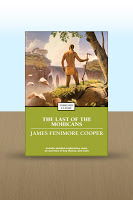
THE LAST OF THE MOHICANS by James Fenimore Cooper


Well, this one is a doozy. I am sorry I could not find you an electronic image of the cover of my edition. It shows the Native American fighting the British guy, and for some reason the wind is blowing up the former’s loin cloth so you can see his butt. Full on, dead centre, a big butt, in the middle of the cover. It is very strange. Very strange. What is that supposed to mean? Borderline gayness combined with borderline racism? Actually, possibly this is also a good strapline for this whole book.

Basically, there are these two British girls and this British guy who is protecting them. They are betrayed by their evil Indian guide(!), Magua. They are then saved by the good Indians(!), a young one (Uncas), his dad, and this other white guy (whose always going on about how he is a man ‘without a cross’) who has been totally absorbed into the Native American lifestyle (thus he has to tell us all the time about his lack of cross). I can see why they made this book into an action movie, because it is just action sequence after action sequence after action sequence, enlivened by a bit of romance and some stupid disguises.

I don’t know which is more racist in its portrayal, the evil Indians or the good Indians. At first I was thinking, wow, way to write to the stereotype; but then I read on the internet that I guess Cooper’s book was actually a huge part of what created the stereotype. Interesting. There’s lots of ‘savage’ this, and ‘uncivilized’ that. But on the other hand, when Uncas dies, his father is mostly comforted by the white guy (WITHOUT a cross, let’s emphasize) who says how they serve the same god and will run on the same paths on the happy hunting grounds, which is sweet. And I guess at the time Cooper wrote it, a lot of people thought he was too kind to the Native Americans, because he often writes in admiration of their fortitude, courage etc etc. So, obviously, let’s not judge him by our standards.

Let’s not even get into the women, because its a close run thing as to whether it’s more sexist than it is racist. And we are not judging him by our standards.

We’re fairly lucky I can even tell you this much about it, as I almost gave up on page 17. This guy is some WORDY. And we know I like wordy, but this was almost too wordy even for me. Check it out: “Receiving no reply to this extraordinary appeal, which, in truth, as it was delivered with the vigour of full and sonorous tones, merited some sort of notice, he who had thus sung forth the language of the holy book, turned to the silent figure to whom he had unwittingly addressed himself, and found a new and more powerful subject of admiration in the object that encountered his gaze.” Ye gods. I kept going, but I almost gave up again when instead of cooking he referred to “undergoing the culinary process.”

Onwards and upwards. (In which series of childrens books is this an important phrase, at least in the last book? Extra points if you know)

THE SMALL HOUSE AT ALLINGTON by Anthony Trollope

Yes, I’m on a massive Trollope kick. There’s no denying it. He’s just orderly. His world is rational. I LOVE it. I specifically saved this book for a long plane ride I had, and it was awesome. It’s just amazing how a book with a strong plot can erase an airport, annoying seat mate, etc etc. Not that I also didn’t watch 3 movies (Dear John – AVOID!, Remember Me – Robert Pattison and 9/11 – nuff said; and Green Zone – MOSTLY AVOID!) Anyway, in the small house at Allington lives a young lady called Lily Dale, apparently one of Trollope’s best loved heroines. Her cousin brings a young man Mr Crosbie down to stay, and the two fall in love. He asks her to marry him and she accepts.

This is usually where most Trollope novels end, but with this one our problems are only just beginning. Mr Crosbie is much admired at the Civil Service, where he works, and uses his small income to impress. He realises that if he gets married he’ll be trapped in a small house with babies and have hardly any income at all. A very modern worry really. So like two weeks later he asks this titled lady he’s known for some time to marry him instead. She also doesn’t have much money, but he thinks a titled connection will be good for his career, and he likes her well enough. She’s been on the market 14 years, so decides to cut her losses and accept.

Lily is made totally miserable by this desertion. Interestingly, so is Crosbie. He finds he has nothing in common with his new wife, and is expected to keep up a way of life way beyond his income. In addition, his social circle are not impressed with him for jilting Lily. He gets attacked at a train station by one John Eames, who is in love with Lily, and wants to avenge her. He asks Lily to marry him, and she refuses, saying she is married to Crosbie in her heart. Which is a bit bizarre.

What I loved about this book was the writing style (smooth as butter!), the dilemma of Crosbie (it was very interesting to see someone make personal calculations of that kind) and of course meeting people from the other novels in the series. It’s like coming across a different period in your life, quite unexpectedly, because I read some of these novels ages ago.

Last: did you know Trollope wrote every day for three hours, without fail? 250 words every 15 minutes, and he said he didn’t understand all the agonising and wall staring; it’s just discipline. He said he attributed his whole success in life to the discipline of early hours. Let’s put that in our lazy pipes and smoke it.

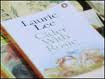
CIDER WITH ROSIE by Laurie Lee


This is an apparently quite famous memoir of a childhood spent in the Cotswolds immediately after the First World War. This guy is one of the youngest in a family of eight. His father has taken a job in town, and never comes to the country, simply sending money (and not exactly tons of it) to his wife to look after the children. Not all of them are hers; some are his from a previous marriage. But luckily for him he is not too bothered by any of them.

The book is quite poetic in style, and evokes quite beautifully the country life. It’s also quite interesting from a historic point of view. On the one hand, everyone seems very happy, in a sort of wasn’t village life wonderful kind of way, but then on the other hand people keep killing themselves. So that was weird.

Anyway, it was a good book I guess and has sold 6 million copies but it didn’t do much for me.

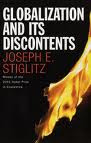
GLOBALIZATION AND ITS DISCONTENTS by Joseph E Stiglitz


This book could also be called WHY I FUCKING HATE THE IMF by Joseph E Stiglitz. This guy but really hates the IMF. He goes through various economic crises – the East Asian one of the 90s, and the end of Communisum in Eastern Europe being the main ones, and castigates the Fund’s mindset, policies and practices. In short, there’s nothing he doesn’t fucking hate about the IMF.

Basically, the Fund was set up to ensure that if any country got into deep economic trouble, there would be a body that existed to help it out. In the Great Depression of the 1930s, it was found that government spending helped resuscitate the economy. I guess that’s kind of Economics 101. The Fund was supposed to help countries stay stable, and when they weren’t, help them out.

According to Stiglitz, the IMF was run by fundamentalist free market thinkers. Thus, their definition of what was best for a country was always less government, no matter what the circumstances. This worked well when the Fund dealt with some South American countries, which had massive governments and bloated budgets, but not so well in many other countries, especially when their economies were having a downturn. They’d insist on less government, and less government spending, which tended to make everything worse. They’d also try and prop up the exchange rate through billions in loans (which the residents of say, Indonesia, had to pay back in the end). However, they’d somehow only manage to prop it up for long enough for foreign banks and local fat cats to get their money out and then the whole place would fall apart, with the poorest hardest hit.

So anyway, the problem I have is that I don’t much about economics, and he doesn’t present the opposite view, so I’ve no idea how right he is. I have to say, it sounds pretty right to me. One thing he points out is that most of the people who run the IMF are from a very small group – finance ministers and bankers, who all tend to have very similar ideas about what is best. Apparently it’s common to go from the IMF right to a major global bank and back again. I mean, even if you’re not a monster or whatever, it’s clear whose interests you’ll be serving. Certainly not the starving village guy in Indonesia. And despite the IMF being a public institution, there’s not much accountability to any public, or much public debate. Thus, while a guy in a village in Indonesia is paying, for sure, he doesn’t have a say.