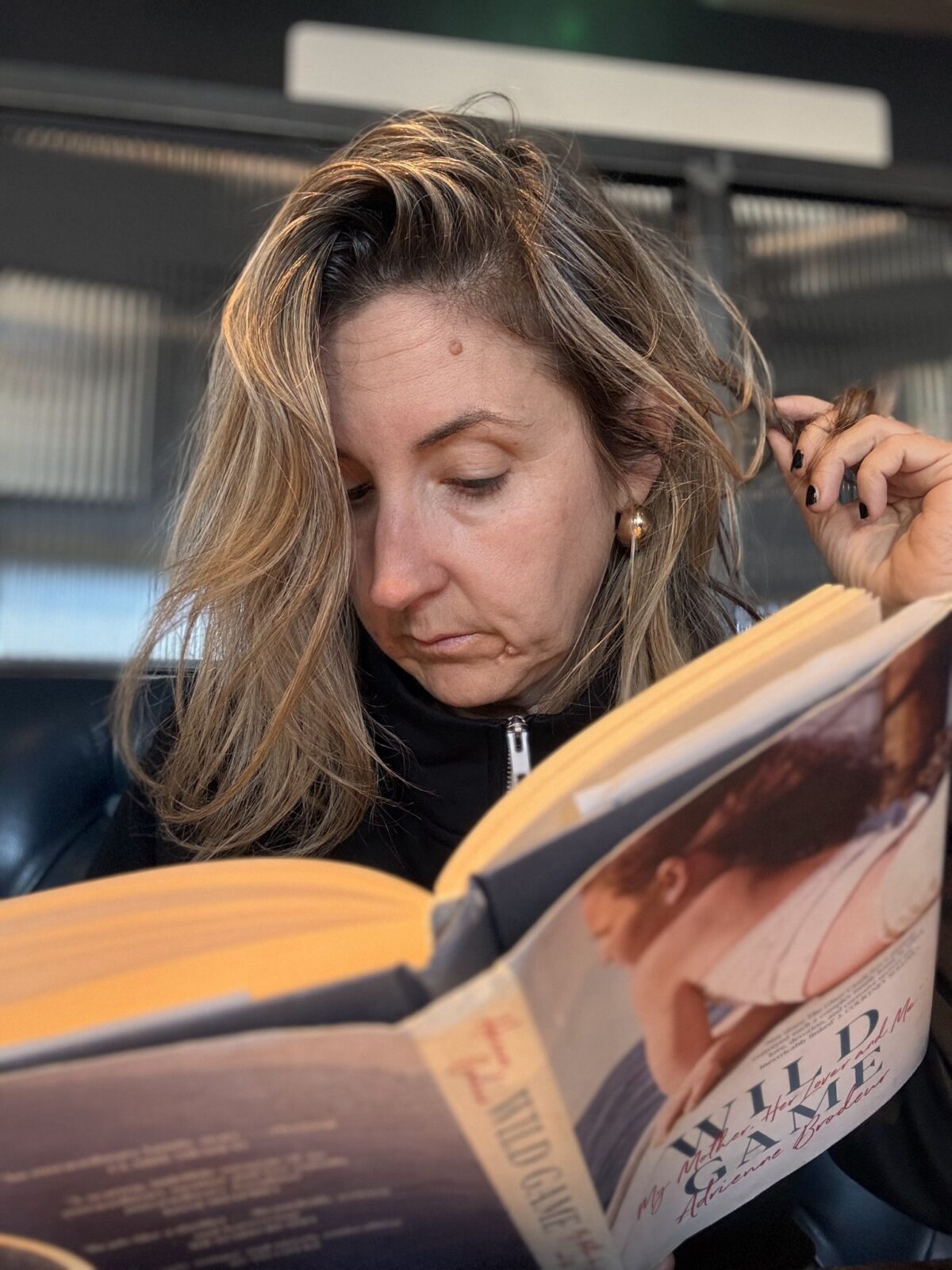
WILD GAME by Adrienne Brodeur

Words fail me on this one. The publishers have gone with a kind of cheesy womens-fiction cover, which is really to undersell how wild and weird this memoir is. It opens with the author as 14 year old being woken up by her mother in the middle of the night. Her mother excitedly tells her “Ben Souther kissed me!” She wants her to share in her happiness. You may wonder who is Ben Souther, to which I will tell you: Ben Souther is her HUSBAND”S BEST FRIEND. What?!

Now it’s slightly less bad than it first appears because the husband is the 14 year old’s stepfather, not biological father. However, he’s been in her life since she was 8, and they have a good relationship. The mother still expects her daughter to not only be happy for her but to actively help cover the affair up. So for example she always invites her mother and Ben to go for a walk after dinner, so they can go to the guest house and ‘talk.’

This messed-up situation goes on for TEN YEARS. Her brother does not know, so she also has to lie to him. She is incredibly lonely and increasingly crazy with the buden. Eventually the stepfather dies and the mother gets to marry Ben. Now she has what she wants, she sort of cuts her daughter out. It’s hard to describe how awful this is. And yet the book is not bitter. Towards the end, she says something along the lines of ‘my mother loved me as much as she was able to love anyone.’ This sounds bleak, but you come to understand how actually it is kind of an acceptance and a way to peace.

SURPRISED BY JOY by CS Lewis

Here is an unusual memoir: a memoir of a religious conversion. There is a prologue, apparently designed to put us off, in which he describes this – his first attempt at memoir – as the most ‘suffocatingly subjective’ book he has ever written. I loved this phrase. Everyone acts like our subjective experience is so important, like we should try and understand ourselves, and etc etc – and I just love how he sort of dismisses this whole idea out of hand, as if your own personal experience is self-evidently extremely limiting.

He has other interesting observations. Try:

“Dates are not so important as people believe. I fancy that most of those who think at all have done a great deal of thinking in the first fourteen years.”

And, on what drives some people to fear insects:

“we see fully realized the two things that some of us most dread for own species -the dominance of the female and the dominance of the collective.'”

That’s more ‘interesting,’ than interesting, perhaps.

Let’s get into how much sex there was happening at his high school. The older boys were called Bloods, and we got into a long discussion of a second group, the Tarts:

“A Tart is a pretty and effeminate-looking small boy who acts as a catamite to one or more of his seniors, usually Bloods. . . They were not like slaves, for their favours were (nearly always) solicited, not compelled. Nor were they exactly like prostitutes, for the liaison often had permanence, and far from being merely sensual, was highly sentamentalized.”

He does note how, given he is known as a religious writer, people might be shocked that he is writing of these “impure loves” without condemning them. However, he says “the sin in question is one of the two (gambling is the other) which I have never been tempted to commit. I will not indulge in futile philippics against enemies I never met in battle.”

I love the generosity of this idea, that he won’t comment on sins he has never had to fight against; its unexpectedly humble. He has a lot of bad things to say about the Bloods, who were mostly bullies, but ends the chapter with something rather unexpected. I was not paying attention to my dates, nad did not realize we were in 1914:

Peace to them all. A worse fate awaited them than the most vindictive fag among us could have wished. Ypres and the Somme ate up most of them. They were happy while their good days lasted.

You will see we have not even got to the conversion yet. In the prologue, he says: ‘”I never read an autobiography in which the parts devoted to the earlier years were not by far the most interesting,” and I guess he’s correct. The conversion was in itself quite unspectacular, happening on the top floor of a bus in London one evening in the 1930s. I find something rather beautiful about that. I am sure that bus route is still running. It should get its own blue plaque. I just love the idea of how full London is of dead people’s personal history. I am sure every square of sidewalk has its story of heartbreak and first kisses and murder and etc.

HEAVY by Kiese Laymon

This memoir is much beloved, but not by me. I’m sure there is an interesting life story in here somewhere, but I couldn’t find it. For me it was kind of buried under style. For example: he addresses the whole thing to his mother ‘you wanted me to be a strong man’ etc. Which I guess sounds cool in theory but I wasn’t feeling it. One thing I will recall from this book though is the one day when he came home from school and drank an entire bottle of ranch dressing in one go. I’ll leave that with you to think on.

THE SECRET DIARIES OF MISS ANNE LISTER – I KNOW MY OWN HEART ed by Helena Whitbread

Now here are the diaries of a 18th century lesbian. I don’t know what I thought was going on back then, but DAMN. Charmingly, they were discovered by a PhD student who was looking for a subject in her home town of Halifax, so she would not need to travel too much. She was reading the letters of Anne Lister, and then (as she put it) the librarian changed the next decade of her life with seven words: “Did you know she had a diary?”

The diary, which in total runs to five million words, was half in a code that Lister invented. The family had the key to the code, but had suppressed it these two hundred years, because what that coded stuff was about was super gay. It is charming, and it is also sad.

The charming part is how she keeps falling in love with everyone. Here she is when a woman responds to her complimenting her bonnet:

“She seemed pleased, saying she thought I did not notice such things as these. I said no, not in general. Some people might have sacks about their heads & I not know, but there were some whose ribands I could count over the last seven years.”

She is also constantly swearing off love. Just like people centuries later, she keeps being “determined to devote myself soley to study,” and then not three days later falling in love again. The sad part is that she is actually in a long distance committed relationship with a woman called Mariana. It’s long distance, because at the time of the diaries, Mariana has gotten married (for the money) but this does not stop the women from considering themselves a couple. To give you a sense of all what goes on, let me just say Mariana gives Anne an STD (called ‘the whites’) which Anne then gives to her hookup Isabella (who btw is a bottle-of-wine-a-day drinker). There’s a lot of ‘treating’ herself by injecting herself with pepper.

One also learns a lot about the eighteenth century, not least how horrible the food is. Try this sample: “My aunt’s bowels being far from well, & myself very bilious, we had minced veal (white) & a light batter pudding with a lump of preserved apricot on top”

Probably what I most liked about the book is the intimacy. She really tells you her truth. As she puts it: “What a comfort is this journal. I tell myself to myself & throw the burden on my book & feel relieved”

There are lots of moments when you feel her touching you across time. Like this one: “They are clearing my room that I am sitting alone in the drawing-room . . . I feel rather low. I must turn my mind into another train of thought.”

She had ambition to be a writer, but unfortunately died of a fever while on holiday in Russia at 50. Strange to think she has achieved a certain kind of fame anyway. I’ll try and stop now, because this woman’s life was very interesting. I recommend you wikipedia her, I haven’t even got into her first love who was a mixed race girl who ended up in an insane asylum, or the scraping her teeth with a pen knife for a half hour at at time, or the non-binaryness, or the electrifying machine experimentation –

A HYMN TO LIFE by Gisele Pelicot

You probably read about this woman in the news. In her late 60s she found out that her husband had been sedating her and then inviting strangers over to rape her. (WHAT FOLLOWS IS ROUGH SO SKIP IT IF YOU NEED TO) This would have been terrible if it happened once. It happened 200 times. Even more horrifying was how he dealt with her ensuing health problems. You don’t get sedated that often without impact, and she struggled with long memory black outs, hair loss, etc. She thought she was going to die of a brain tumour like her mother, who died when she was 9. She also had dental problems, because she was orally raped so violently. This husband came with her to the doctors and specialists, acting concerned, all the while knowing exactly why she was so unwell.

This book is her account of finding out about what was happening, and the trial that followed. As shocking as what happened was, I found it even more shocking to see how she responded. This lady is just incredibly brave. She really struggled to watch the videos he made of all the rapes, but once she did, she realized she needed to go public. She wanted it clear that she was not ashamed to be in these videos; the perpetrators ought to be. Sounds basic, but the courage to do it is just incredible. She is a pretty ordinary lady, not a big feminist, left school at 15 etc, and I did think how proud the feminist movement should be, that she felt ready to step up into that experience.

One other thing I admired was her courage in accepting that she never knew her husband of fifty years. Imagine how difficult it would be to feel a huge chunk of you life was a lie. I’m amazed she is still standing.

MOTHER MARY COMES TO ME by Arundhati Roy

Here is a memoir about the author’s mother. To give you a flavour, let me tell you that the epigraph at the beginning is to the author’s brother: “For LKC: Together we made it to the shore.” Clearly a lot has gone on.

The opening is the author telling us that she wrote this book to deal with her grief, about which she is: ‘puzzled and more than a little ashamed.’

Her mother leaves her husband because he is an alcoholic, and ends up finding a way to go from teaching in one rented room to founding a whole school. It’s a titanic effort. Here is the author:

“It has taken me years to come to terms with the fact that I was a middle child, one of three siblings, not two. My older sibling was a boy, and my younger sibling was a school. There was never any doubt about who our mother’s favourite child was. She loved, fought for and protected her youngest child with everything she had. That kind of focused, ferocious love, regardless of what it may choose as its object, is a blessed love. The challenge for those of us who are not chosen, and instead watch love pass us by, is to learn from it, marvel at it, and not grow bitter and incapable of love ourselves.”

Her mother can only be described as a real piece of work. Both her children ‘go no contact’ (as Reddit would say) for many years. But they can’t escape how much she formed them, and what she achieved for them, and they both get sucked back in. The book gets into the overall life of the author, which is interesting in its own way (who wins the Booker for their first novel?!?) but somehow lacks the immediacy of the parts about her mother. I wonder for how many people it’s true that their entire adult life has less emotional energy than their childhood

SECOND CLASS CITIZEN by Buchi Emecheta

Here is a semi-autobiographical novel about what it means to really be ‘self-made.’ The main character is born to a low income family in Nigeria, and with zero help (and some resistance) from them manages to get herself a scholarship to high school. This opens the door to university, which she can only attend if married (long story).

She graduates, gets a great job, and her husband moves to London to study. She follows him, with two of their children, and finds him overwhelmed in this new context. He struggles without his extended family, and with the racism, and deals with it by beating her. She gets another great job, while he ‘studies.’ He refuses to allow her to use birth control, despite them having no money, because according to him he can stop pregnancy with his mind. She ends up with five children by 23, and is still the only one with a job.

She eventually writes a novel, encouraged by her colleagues at the library. It’s the 60s, so its all in exercise books, and her husband BURNS IT. This is the moment where she breaks and leaves him. Two weeks later he hunts her down and nearly kills her.

This probably sounds pretty bleak, like it’s a story of domestic violence. But weirdly, this is not at all how it reads. I can only describe it as joyful? It is carried on so much by her energy and her optimism and her love of her children. It’s kind of a classic immigrant story about building your own life, and knowing you are beating the odds. Perspective truly is everything.

LOVE’S WORK by Gillian Rose

The author wrote this memoir after her diagnosis with cancer at 46. She was dead by 48. It’s a highly compressed, painful read. She was a philospher, and you can tell. It’s not clear if this book is personal story or work of philosophy. Maybe all personal stories are works of philosphy, but not so clearly as this one. It’s remarkably dense:

“My journey to Auschwitz and east across Galicia to Belzec on the border of Ukraine did not affect me in the ways I had expected; it was the unexpected, rather, which provided the. nodes of enigma that compressed incompatible and uncomprehended meanings together.”

What?

Here is some rather beautiful lines from Swinburne. Let’s all think about death:

“From too much love of living,

From home and fear set free,

We thank with brief thanksgiving

Whatever gods may be

That no man lives for ever,

That dead men rise up never;

That even the weariest river

Winds somewhere safe to sea.”

A MOTHER’S RECKONING by Sue Klebold

Not sure how I got into this, but here is a memoir by the mother of one of the shooters at Columbine High School, Dylan Klebold. First thing to note, which really astonished me, was that school shootings were extremely uncommon at the time of Columbine. Imagine how bad it would be to find out that your son is a school shooter, without even having a model of what a ‘school shooter’ is.

This woman’s experience is truly jaw-dropping. Dylan, far from the bullied outcast I always thought he was (trenchcoat mafia etc), had in fact a bunch of friends and had been to the prom a few days before. He was also a perfectionist who was the child they ‘never had to worry about’. I guess I should not be surprised: teenagers lie to their parents. It is just astonishing how people do not know each other, even if they see each other every day.

What struck me particularly was that Dylan was not just a murderer, but also a suicide. When they eventually found his journals and went through them, it turns out he had been thinking of ending his life for at least two years. Even the week before the shooting he had been debating with his father on what dorm room to choose. Apparently this kind of apparent ‘planning’ is common in suicides – something for us to bear in mind when deciding how worried to be about someone. Her main takeaway after a decade of agonising is the simple one, that she wished she had listened more and talked less. Poor lady.

I cannot imagine how she survived this level of shock and bereavement. It puts one’s own problems very much into perspective i.e., they are minor.

STOP TIME by Frank Conroy

Do I really need another coming of age story from an American man?  Apparently so. I’ve enjoyed this one.  Mostly, it reminded me of how boring childhood used to be.  I know people talk about it a lot, but this memoir really brought back to me what it was like before phones and television. God, we were bored.  And I had my cousins and a library card, so I was not even as bored as this guy, who had neglectful parents and a shack in Florida. 

I am always awed/frightened by the idea of memoir.  Imagine sitting down and actually trying to recall your childhood?  It feels frighteningly impossible and also frighteningly possible.  This deep in some Pandora box territory.  I also really don’t like the idea of fixing the past into my specific narrative about it.  I think the past does best when it is constantly changing, just like the future.   That said, please enjoy this baller analysis of his step dad:

“Because for all his knocking around his view of the world was incredibly naïve.  He believed important jobs were handed out in nightclubs by impulsive millionaires and that he was the sort of man they might be given to.  Spoiled all his life . . . he deeply believed that the good things in life were given to one.  Food, clothing, and the bare necessities had to be earned, but after that it was a question of being in the right place at the right time, or knowing the right people or simply being lucky.  It never occurred to Jean to work hard anything except menial labour.  He was always above his work, the secret possessor of an inner wealth untouched by the world – his image of himself.” 

I came to this book from seeing that David Foster Wallace said it was the book that made him want to be a writer.  I just love author’s recommendations of other authors.  It’s sad this was only available in second-hand.