SOME TAME GAZELLE by Barbara Pym

This book is about a pair of middle-aged spinsters living in an English village. It’s a sad, wise novel about the kind of small fantasies we need to keep ourselves going, especially when life has not turned out as we hoped.

Bizarrely, it turns out the author was just twenty-one when she wrote it. Apparently it progress forward her, and her sister, thirty years in the future. Their various university boyfriends also appear, older, fatter, and having rejected them.

The title is based on a poem by Thomas Haynes Bayly:

Some tame gazelle, or some gentle dove:

Something to love, oh, something to love!

One sister is still mooning over the local ArchDeacon, who decided to marry someone else decades ago; the other is always developing crushes on much younger curates, who are continually disappointing her by leaving to evangelize the Africans. Here are the kind of concerns, on knitting for the ArchDeacon:

When we grow older we lack the fine courage of youth, and even an ordinary task like making a pullover for somebody we love or used to love seems too dangerous to be undertaken. Then (the wife) might get to hear of it; that was something else to be considered. Her long, thin fingers might pick at it critically and detect a mistake in the ribbing at the Vee neck; there was often some difficultly there. . . . And then the pullover might be too small, or the neck opening too tight, so that he wouldn’t be able to get his heard through it. Belinda went hot and cold, imagining her humiliation.

Curiously though, both women do receive proposals over the course of the book, and both turn them down; there is an unacknowledged but clear view that in fact, if they could but see it, they are happy as they are, with their gardens and their puddings and their choice of corsetry.

It’s a very delicate little book, almost entirely about women, and domestic matters. I’m amazed, patriarchy being what it is, that it ever got published, because on the surface the concerns it embraces could not be smaller. The point being I guess that life is made up, mostly, of small concerns. And you have to find a way to live it anyway.

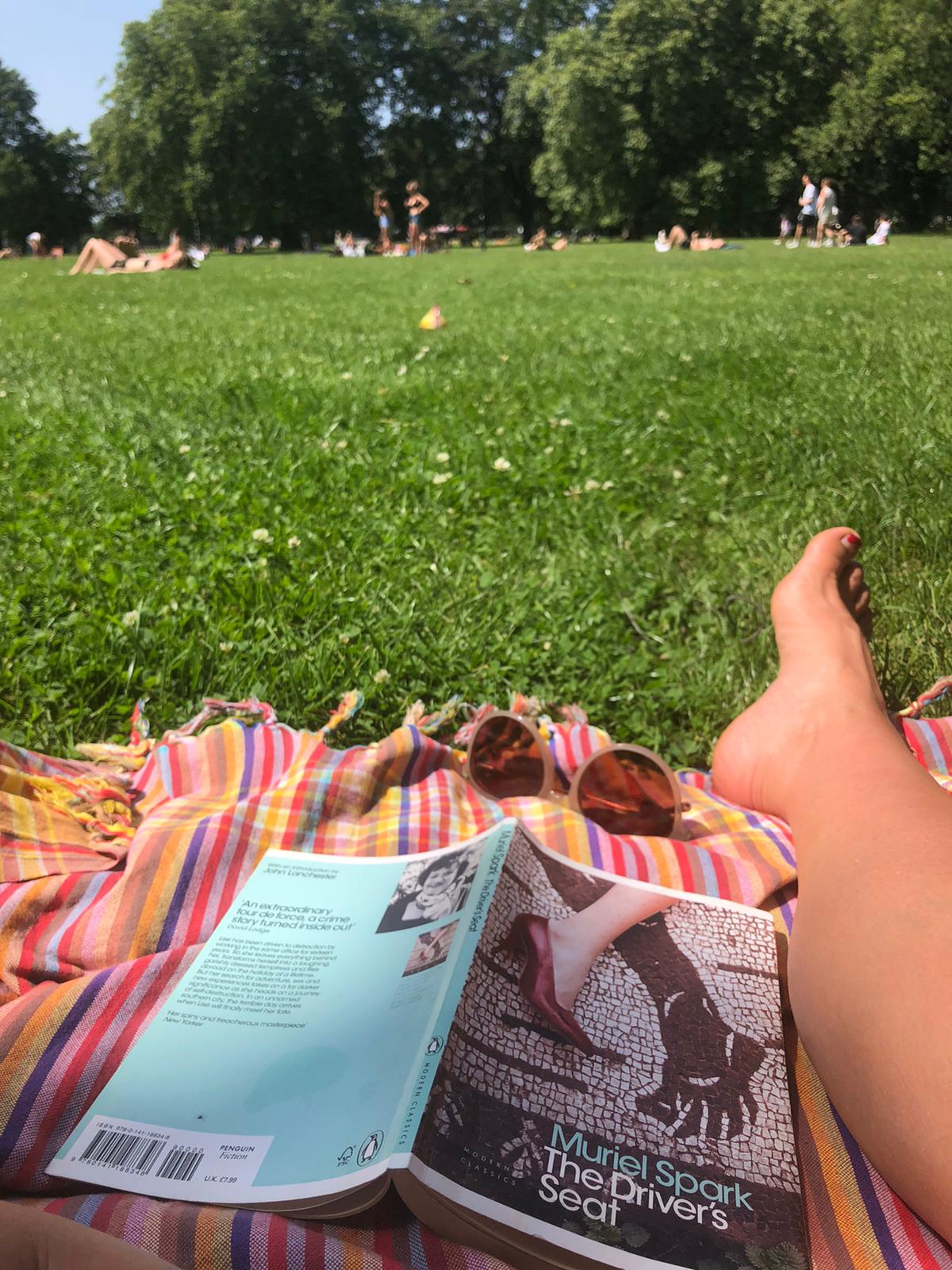
On the picture, by the way: it’s my first audio book!

THE INVENTION OF NATURE by Andrea Wulf

In this book a man with a large unearned income has a great time and inspires lots of others to do the same.

Alexander von Humboldt was so famous that at his centennial in 1869 there were huge parades for him across cities in Europe and America.  He has more things named after him than anyone else who has ever lived (rivers, plants, geographical features, a part of the moon).  And yet, today, it is a bit: Humboldt Who?

Humboldt did not identify or discover anything in particular.  What he is famous for is his worldview.  He put forward the idea, revolutionary at the time, that nature was fragile, heavily interconnected, and at great risk from human intervention.  It’s an insight that was so influential that today it sounds obvious. 

It was not an easy road for Humboldt.  Okay, I lie, it was a pretty easy road.  He had a wealthy mother, so the second she died he stopped pretending to study medicine and was off to South America with his boyfriend (or as he liked to call him, his botanist).  He went there allegedly to discover the tributaries of the great Orinioco river, which surprised the locals, who knew them well and to his disappointment could describe them in detail.  While there he studied everything from the colour of the sky to the nature of the soil, and came to a forest of conclusions, almost all of which are correct: he invented isotherms, he identified deforestation, he called it on tectonic plates; he even flagged the dangers of ‘great masses of steam and gas’ coming from cities.  He categorically condemned slavery and the idea of racial inequality in terms that are almost shockingly modern.

After covering Humboldt’s long and cushy life, the book goes on to cover all the many other naturalists who were inspired by him, including Darwin, Thoreau, and Marsh.  Probably not coincidentally, these guys also had a ton of unearned income.  They also had disapproving parents, who either died or got worn down by their sons’ enthusiasm.  And there is a LOT of enthusiasm.  Here’s Darwin to his father:

I am at present red-hot with Spiders!  

Humboldt got so excited that when he ran out of paper he would just scratch away at his desk rather than stop writing, and he did begin to worry he was losing his mind.  Muir, meanwhile, is reported by a guest to have run out of his cabin when the earth started to shake shouting happily: “A noble Earthquake!!!”   He was apparently excited to study it.  But one does wonder on his methods, as he later wrote to Emerson that “he had asked two violets what they thought of the earthquake, and they had replied ‘it’s all love’.”

Marsh was probably my favourite, partly because he was one of the only ones who had to find a way to fit his passion in around actually having to work for money.  As he put it, earnestly, in a letter, explaining the kind of job he was after:

small duties and large pay . . .

I mean aren’t we all.  Eventually he gets a job as an ambassador, which gives him lots of time to consider irrigation around the Nile, but still he complained:

I have been entirely disappointed as to the rest and relaxation I looked for

Oh sweetheart.

I have been strangely educated on many topics by this book. That there were 15,000 ships a day entering London in 1802; that the state of Nevada was nearly called Humboldt; etc.  But I think what I mostly take from it is the fact that you can for sure live your best life.  Now, I am rather jealous that probably no one can ever be as true polymath, as Humboldt was, as there is now just too much to know.  And of course, the money thing is a problem. But I am inspired by the joy these guys took in what they were doing, how they poured all their lives into having a wonderful time. 

As John Muir put it:

I’m in the woods, woods, woods, & they are in me-ee-ey

And who cares what anyone else thought. 

THE HANDMAID’S TALE by Margaret Atwood

I enjoy a feminist dystopia as much as the next person, but in this case, maybe just stick with the TV show.

THE HANDMAID’S TALE is set in an alternative future where fundamentalist Christians have taken over the USA.  Women have been returned to exceedingly traditional gender roles, i.e., gross old guys get whatever they want.  They have wives, they have female servants, and they have concubines.  Sounds pretty sweet.  I mean for the gross old guys.  Grisly for everyone else. Atwood said one of her rules in writing it was that no atrocity should be included that had not actually happened in history, and it is depressing to contemplate how much of this future dystopia is basically just a re-telling of the past. 

It reminded me a bit of STEPFORD WIVES, in which ordinary men are given the option to have their wives’ brains rewired to produce a ‘perfect’ woman.  What makes that book so compelling is how believable it is that given the chance, most men would take that option. 

So, it was interesting; but I can’t say I enjoyed this book that much.  It was all a bit lyrical and literary for me.  There were some very questionable dreamlike sections.  The TV show cut all those bookish bits.  The book without the book.  Much better!

DEPT OF SPECULATION by Jenny Offill

Here is someone who has a mental breakdown because she gets cheated on.  I don’t know, I know it’s not very nice, but my view is: toughen the f**k up. 

Partly this view comes from the fact that this novel refuses to give any character a name, calling the main one ‘the wife,’ and the other one ‘the husband.’ I always find this profoundly pretentious.  Even worse, at the end, it abruptly shifts to using the first person singular.  I mean: VOM.   And all this to mostly tell the story of this couple who moves out of Brooklyn to the suburbs because it is cheaper. 

That said, here are two things I did like:

One, a quote from an 1896 book on advice for brides:

The indiscriminate reading of novels is one of the most injurious habits to .which ‘a married woman can be subject.  Besides the false views of human nature it will impart . . . it produces an indifference to the performance of domestic duties, and contempt for ordinary realities

I have long wondered why I am indifferent to domestic duties.

Two, this which I find sadly and profoundly true:

But now it seems possible that the truth about getting older is that there are fewer and fewer things to make fun of until finally there is nothing you are sure you will never be.

YOUR BEST YEAR YET by Jenny Ditzler

A re-read of a book from a couple of years ago. I read it again to help me get some discipline and produce some new year’s resolutions. 2021 has to be a better year than 2020, just vaccines alone, but I’m hoping to give it a push. The blog of last time I read it is here. It’s a pretty good book, I recommend it.

MONOGAMY by Sue Miller

All I have to say to this novel is OK BOOMER. 

It tells the story of a marriage between two older people, and about their circle of friends.  We learn a lot about their daily lives, their dinner parties, their CD collections.  Enjoy this sample:

She had already prepared the white beans with thyme and olive oil for tomorrow’s dinner, and the plan was to put the lamb in a marinade tonight.  But she still had some shopping to do – last minute things.  Back in Cambridge, she stopped at Formaggio, the fancy neighbourhood shop, for cheeses – cheeses and crackers and several kinds of olives.  They had cherry tomatoes that looked nice in the produce section . .

I’m not even going to get into the ‘frisee salad with new potatoes and bacon’ incident. 

The husband is a book store manager, the wife a very under-employed photographer.  What we don’t learn is how they are funding two homes, and two kids, and daily fancy meals, on those salaries!?!  This is the kind of lifestyle you only get to have if you were born in the 1940s or 50s. MONOGAMY was like having my nose rubbed in inter-generational economic unfairness for 336 pages. I already have had quite enough of it from when those selfish people voted Brexit, secure in the knowledge that they would not be the ones working to pay their fat pensions.

The hook of the book is that after the husband dies the wife finds out he had a brief affair.  Rest assured, there is nothing revelatory in this.  Everyone acts like they can’t imagine why someone married thirty years might have an affair and yet still love their wife.  I mean, snore. 

There was only good part, which was where we learn about how the husband gave up on writing a novel:

It had felt liberating to acknowledge this to himself and others, to shed his painful sense of the obligation to be somehow remarkable; but it left him with the unanswered question of what to do with his life, and simultaneously the realization that working on the novel endlessly had been a way to avoid facing that question.

I like the idea of giving up on being remarkable.

PREP by Curtis Sittenfeld

This book reminded painfully me of the nightmarish self-involvement that is adolescence.  It tells the story of a girl, Lee, who gets a scholarship to a posh boarding school and spends the entire time behaving as if it is a concentration camp designed for in-depth examination of her choices by everyone concerned.  I mean check it out kids: you are not that interesting.  No one cares. 

PREP covers Lee’s four years of high school, and is an exhausting accounting of all the stupid things she worries about.  This includes even positive interactions with others:

This anxiety meant that I spent a lot of time hiding, usually in my room, after any pleasant exchange with another person.  And there were rules to the anxiety, practically mathematical in their consistency: the less well you knew the person, the greater the pressure the second time around to be special or charming, if that’s what you thought you’d been the first time; mostly it was about reinforcement.  Also: the shorter the time that elapsed from your first encounter to your second, the greater the pressure; . . . And finally: the better the original interaction, the greater the pressure.  Often, my anxiety would set in prior to the end of the interaction – I’d just want it to be over while we all still liked each other, before things turned.

Eventually as a senior she starts to hook up with a guy she has had a crush on for a long time.  It remains ‘secret’ for reasons that are unclear to her. 

Before and after I was involved with Cross Sugarman, I heard a thousand times that a boy, or a man, can’t make you happy, that you have to be happy on your own before you can be happy with another person.  All I can say is, I wish it were true. 

This did make me laugh.  It’s a lot of peoples’ experience, but it’s not something often admitted.

I enjoyed the book, it was very more-ish, but quite interestingly it didn’t actually go anywhere.  She got older, but no wiser.  I guess we typically assume that books have a shape and some kind of resolution (especially when they appear on the surface to be coming-of-age stories) but in this case, there was none.  For a while I found it annoying, but perhaps it’s just honest.  Sometimes I guess it’s true you just don’t change, but stay trapped on the same old hamster wheel. 

THE GLASS CASTLE by Jeannette Walls

In this memoir, a wealthy gossip columnist lives on Park Avenue while her parents live on the streets.  Bizarrely, your sympathies are 100% with the gossip columnist.

There are many memoirs of rough childhoods.  Usually, this comes from some clear cut cause, as for example addiction, mental illness, etc.  Here, it seems to come from an over-abundance of romance and self-indulgence. 

The dad kind of has a semi-excuse, being an alcoholic.  But first, weren’t most peoples’ dads alcoholics in the 1970s?  I’m not really sure that that cuts it. And second, he declines the most basic of help (e.g.,food stamps) even when he is sober.  And this is when these small kids have not had anything other than popcorn to eat in three days. 

The mum meanwhile is a whole other story.  She refuses to work, despite being a trained teacher, for the strong reason that she does not want to.  She wants to paint, write novels, and eat chocolate. When they do get her to briefly work, she complains every morning: “I’m a grown woman now.  Why can’t I do what I want to do?”  

I mean I can’t say I don’t see where she is coming from.  Less attractive is when she tells her daughter, who has been groped, that sexual assault is a “crime of perception,” and even less attractive is when she hides a family size Hershey bar from her very hungry children so she can eat it herself.

The parents are well educated, and so early on, while they are still young and maybe classifiable as ‘alternative,’ they do provide the children with lots of excitement and interesting experiences.  Over time though, without money, ‘alternative’ becomes ‘gross.’  Their children escape them to go live in New York, where they mostly thrive. The parents follow, and weirdly decide to be homeless, despite the offer of help from their (remarkably forgiving) kids and – strange twist – the revelation that the mother owns very valuable land in Texas, and has done for their entire, impoverished lives.

The book has a highly suspicious amount of detail about the author’s life before the age of ten.  I googled it when I was done, fully expecting lots of libel suits, but apparently her family agrees that this is indeed, really bizarrely, how this all went down.   I finished the whole thing in a night, something I haven’t done in a while.

SEA WIFE by Amity Gaige

In this novel a man goes off to live his dreams.  He ends up dead.  Why is this so often the way?  I suspect on some level we don’t want to read about someone leaving their life to do something crazy and it ending well.  Because that raises questions about our own life.

Michael convinces his wife to go sailing for a year with their small children.  He does not know much about sailing, and his wife is resistant at first, and also at last.  But they do it. As the husband says, to the many people who raise objections:

. . I think there’s something wrong with the line of thought that it’s reasonable to defer your modest dream for several decades.  What are we, characters in a Greek myth?  Waiting for the eagle who comes to our liver every day because in a Greek myth, that’s normal?

SEA WIFE is about their year at sea, but also about their marriage.  At first your sympathy is with the wife, because truly the husband does seem kind of crazy, and he apparently voted for Trump.  Over time though, I had to say I came round to his side, because the wife really is useless and whiney.  She is horrified to find they are in debt, because as she explains:   

I never asked questions about money

As if this is a reasonable excuse!  How about you are an adult?  Like what is the guy supposed to do? She also is relentlessly lazy about learning to sail, and then when the husband gets Dengue fever mid-ocean she acts like a lost puppy.  I mean why did Emmeline Pankhurst even bother?

WRITERS AND LOVERS by Lily King

It’s been a long time since I read a book that had a straightforward happy ending.  I enjoyed it: it gave me hope.  Modern literature never ends on “Reader, I married him.”  More like: “Reader, I married him.  And that was the beginning of our problems.”  It’s like we can’t accept that there can be such a thing as happiness – it always has to be equivocal, and coloured by upcoming death. It’s like we think we are too good for happiness.

WRITERS AND LOVERS is about a woman in her thirties who is deeply in debt (student loans), recently bereaved (her mother), recently dumped (poet!), and has been working on her first novel for six long years, with no end in sight.  She pays the bills by waiting tables.  Clearly Lily King has waited tables, because there is a lot of detail on this, and I gained a lot more respect for what is involved in waiting tables. 

Here she is thinking about this ex-boyfriend, or was he a boyfriend, this was part of the problem:

You taste like the moon, Luke said out in that field in the Berkshires. Fucking poet.  On the path a few people are holding hands, drinking from bottles, lying in the grass because they can’t see all the green goose poop. 

For all she is now so miserable she has two competing suitors, and much of the book involves her going back and forth between them.  She also receives rejections for her novel, and I was reminded how many people sacrifice hugely so we eventually get to those few people who manage to do something wonderful.  It’s like the gods of art demand blood.

 At one point she starts to have what appears to be a breakdown.  This for me is always a red flag: here we go with ‘dream sequence’ type writing, but we avoid this.  She sells her novel, she chooses her man: happily ever after.