A YEAR ON EARTH WITH MR HELL by Young Kim

The review I first read about this book was illustrated with a photo of a young Asian woman holding the hand of a much older European man.  The review spent much time discussing whether or not the book is revenge porn, and to my surprise the pornographer is in fact the young woman.

Basically, the guy was married, and had an affair with this lady, and this is the story of that affair.  This is all sounds very salacious but in fact for a book with really a lot of sex in it, it is remarkably straightforward.  There’s a lot of chat about what she wore, and when he did or not text her back.  It was drafted in real-time, as the relationship was happening, which gives it an interesting kind of immediacy.

What I found especially interesting was what this lady did for a living, which, as far as I can tell, was nothing too much.  She had previously been with another much older man, Malcolm McLaren, who she met when she was a student at Yale, and after his death (about which she is clearly heart-broken) she mostly curates his artistic legacy.  She spends her year going between New York and various European capitals, having dinners, going to openings, and wearing designer shoes. I tried not to think the word ‘parasite,’ as of course that is uncharitable.  I guess I like my artists starving.

THE WRONG KNICKERS by Bryony Gordon

Here is a memoir that I thought would be a fun canter through someone’s twenties in London. In fact I found it rather triggering. Will sound dumb, but I guess I had never really thought about what it would be like to come up in this city and not be an immigrant. And let me tell you: it’s very different.

It’s wild to imagine what it would be like to feel free to live in your overdraft. The author was of course not happy about struggling to pay her bills, but she kept doing it, because she enjoyed booze and clothes and cigarettes more. I mean: don’t we all? But I guess if you know full well you have a Plan B, in terms of a family home in Fulham to return to, you have that freedom.

If she is in a flat she doesn’t like, she just leaves. Because she has somewhere to go to. Imagine! One time she gets mugged, and she regards that as a good enough reason to go. And so, wildly, does everyone she knows! I can’t even imagine a London with so much mercy in it.

THE WOMAN IN ME by Britney Spears

I chose this on impulse as an audiobook to listen to on a long car ride, and I did not expect to emerge as TEAM BRITNEY. I am not sure what I thought the #freebritney movement was all about, but WOW I did not realize how right they were.

I knew that in the nineteenth and twentieth centuries it was quite common to get rid of difficult women by putting them in asylums, but did not realize how very much this is exactly what happened to one of the more famous pop stars of our generation. Britney’s father knew exactly what he was doing, because both his mother, and his step-mother, were put in asylums by his father. I am not saying Britney is 100% well, but she was well enough to be forced to do Vegas shows 7 times a week, tour the world, go on morning TV shows, etc. She certainly was well enough to have her own cell phone and choose her own boyfriends and eat french fries if she wanted to!

I can’t believe it went on for thirteen years! It is an appalling story. I recommend it. Britney had a wild and interesting life even before she was imprisoned in plain sight by her father, and it makes for a great memoir.

STAY TRUE by Hua Hsu

Here is a book about grief. It is written by someone born in the same year as me, and tells about his best friend in university, who died when he was a junior. It was eerie to read a book so exactly of my time-and-place. That rarely happens for me. I enjoyed this for example, something I had forgotten about:

Back then, years passed when you wouldn’t pose for a picture. You wouldn’t think to take a picture at all. Cameras felt intrusive to everyday life. It was weird to walk around with one, unless you worked for the school paper, which made picture taking seem a little less creepy.

I’d forgotten about a time before photos were the default.

The story was a sad one. What struck me was how much I now recognize what grief looks like: the guilt about what you could have done differently (oh GOD, the guilt), the retrospective wondering what your relationship meant, and etc. I can’t imagine how the author got together the emotional resilience to write it. I barely had the resilience to read it.

One thing I have been thinking about recently is how anytime someone dies, you read about them in the paper after a stabbing or whatever, there is almost always really bereft family and friends left behind. It’s kind of beautiful to think that every random person you see in the street is so surrounded by love.

DEAR GIRLS by Ali Wong

Here is a set of essays by a stand-up comic, structured as letters to her young daughters.  It is fun and silly.  Here she is on a failed one night stand:

That’s what happens when you spontaneously go home with a fellow struggling stand-up comic or, even worse, an improviser.  (Please says say ‘fuck no’ to those ‘yes and’ mother fuckers).

I have for some reason read quite a few books by stand-ups, and I’m always struck by how incredibly rough it sounds: the travel, the horrible venues, the silent audiences.  I admire it.  I was especially touched by her early twenties, which sound a lot like mine:

Every day in NYC was about spending as little money as possible. 

People don’t talk about that too much, preferring to focus on having genius or technique or whatever, but in my experience being able to live on nothing is way more important

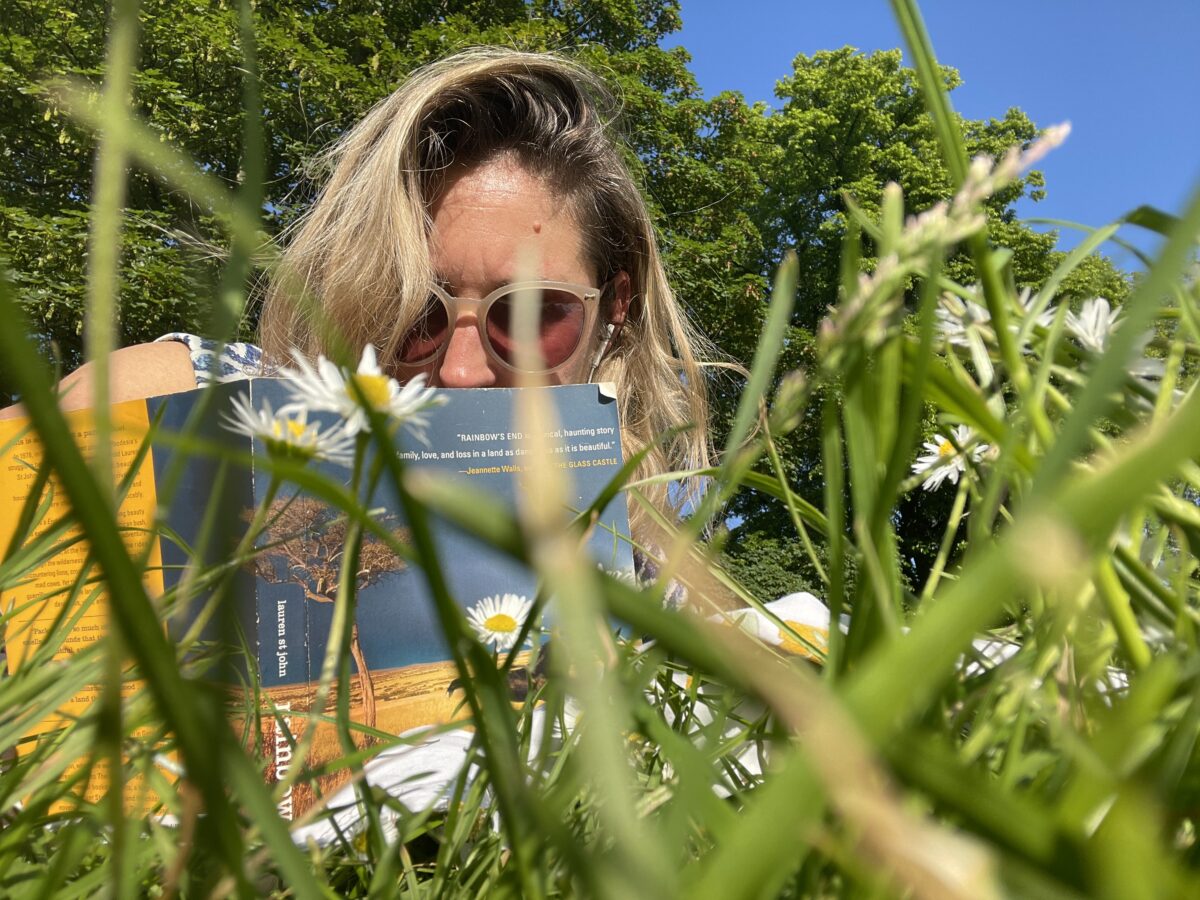
RAINBOW’S END by Lauren St John

Here is a book that aches for the past, and a place. It’s about a childhood on a Zimbabwean farm, and let me tell you it is not recommended reading for the English winter. The author is about ten years older than me, and so bears the unfortunate burden of actually remembering the war. This makes her childhood days on the farm somewhat hair-raising. The farm they live on, Rainbow’s End, was previously owned by a family who were killed by guerillas in the war. One of the family was a little boy who SAT NEXT TO HER IN CLASS. When she moves in she finds HUMAN BLOOD ON HER WARDROBE DOOR.

And then apparently she goes on to have a blissful childhood, as the farm is also a game reserve, and she is mad for horses. She is also big on Zimbabwean food, which I enjoyed, it is not often I hear the joys of Mazowe described as they should be. In any case, it was interesting to read what it was like for young people to see the end of the war, and how it changed their perspective on what it had all been for. I am glad to be spared that burden.

I was struck by how much of Zim life is unchanged form the war. She talked about people ‘making a plan’ which I thought was a more modern framing, to do with our current issues, but apparently not. The book is full of the beauty of the landscape, and of dread. Here is an example sentence:

In late 1979, when our friends Bev and Fred Bradnick (in whose garden Lisa had once found a live grenade) were firebombed by terrorists on their farm on the Lowood Road . .

Can you believe that finding a live grenade is just a parenthesis? In other memoirs that would be a chapter. Bizarrely, what ages the author the most is not the blood on wardrobe doors, or the dead horses, but the discovery her father is having an affair. But there you go, I guess everyone has their own problems.

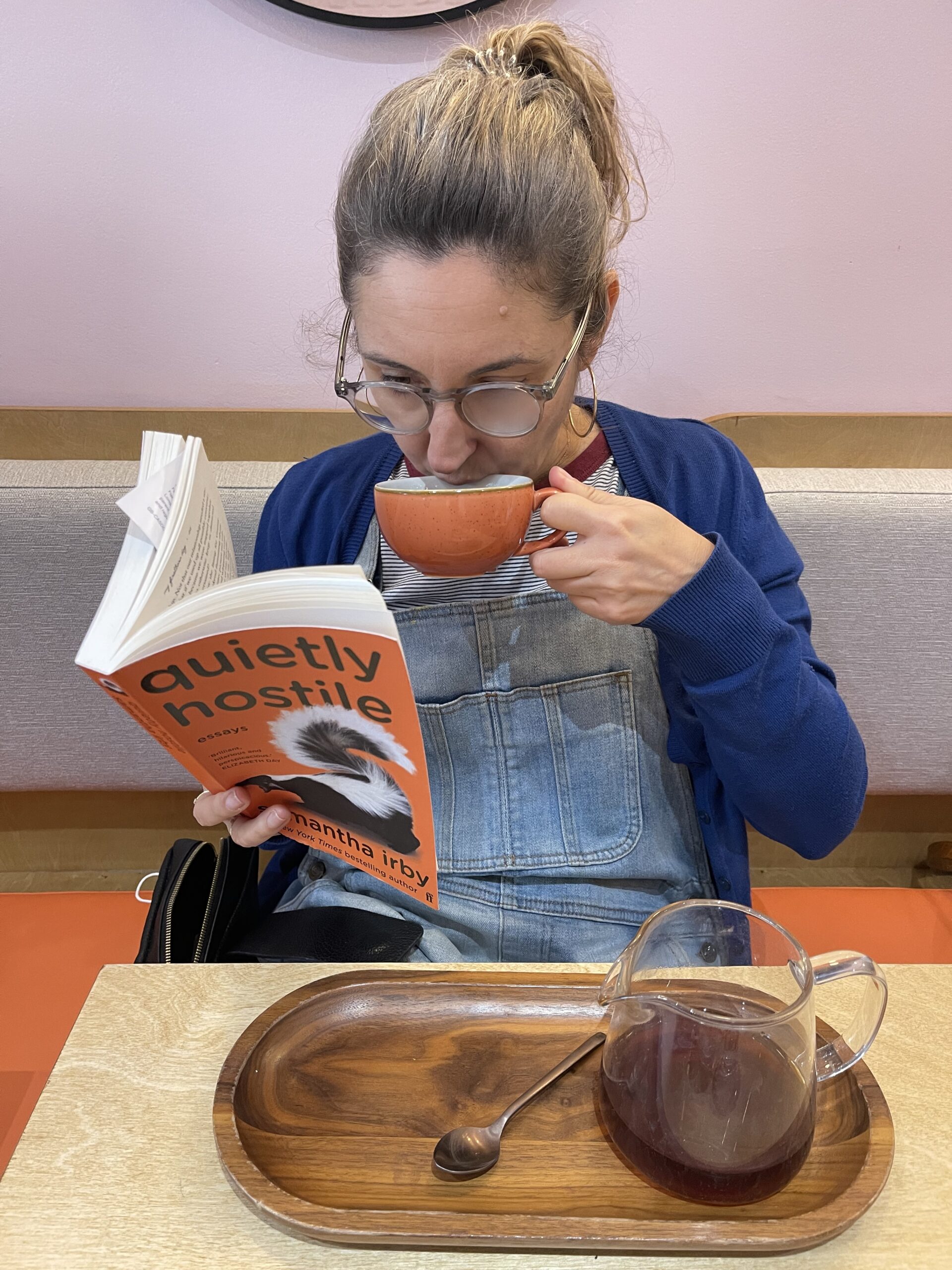
QUIETLY HOSTILE by Samantha Irby

Irby is the only author I’ve read who comes close to Sedaris. I love her three previus books, MEATY, WE ARE NEVER MEETING IN REAL LIFE, and WOW NO THANK YOU. She writes personal essys in the voice of the internet, which I feel is a whole new form, no doubt to be quickly replaced by the voice of or AI overlords.

This fourth book, QUIETLY HOSTILE, I also enjoyed, though perhaps not as much as the others. In part, I guess, I am used to her style, so it delights me less. In part, also, she is doing better in her life, and somehow that always make for a less fun essay. I noticed the same thing with Sedaris: no matter how charming you are, it hard to really warm up to anecdote that involves buying trousers for $300.

In the first books, Irby is a single receptionist in Chicago with a long list of health problems. In QUIETLY HOSTILE she is happily married and living in rural Western Michigan. You ae fond of her, so glad it has gone well, but somehow its not quite as funny. That said, I’ll buy the next one on pre-order too.

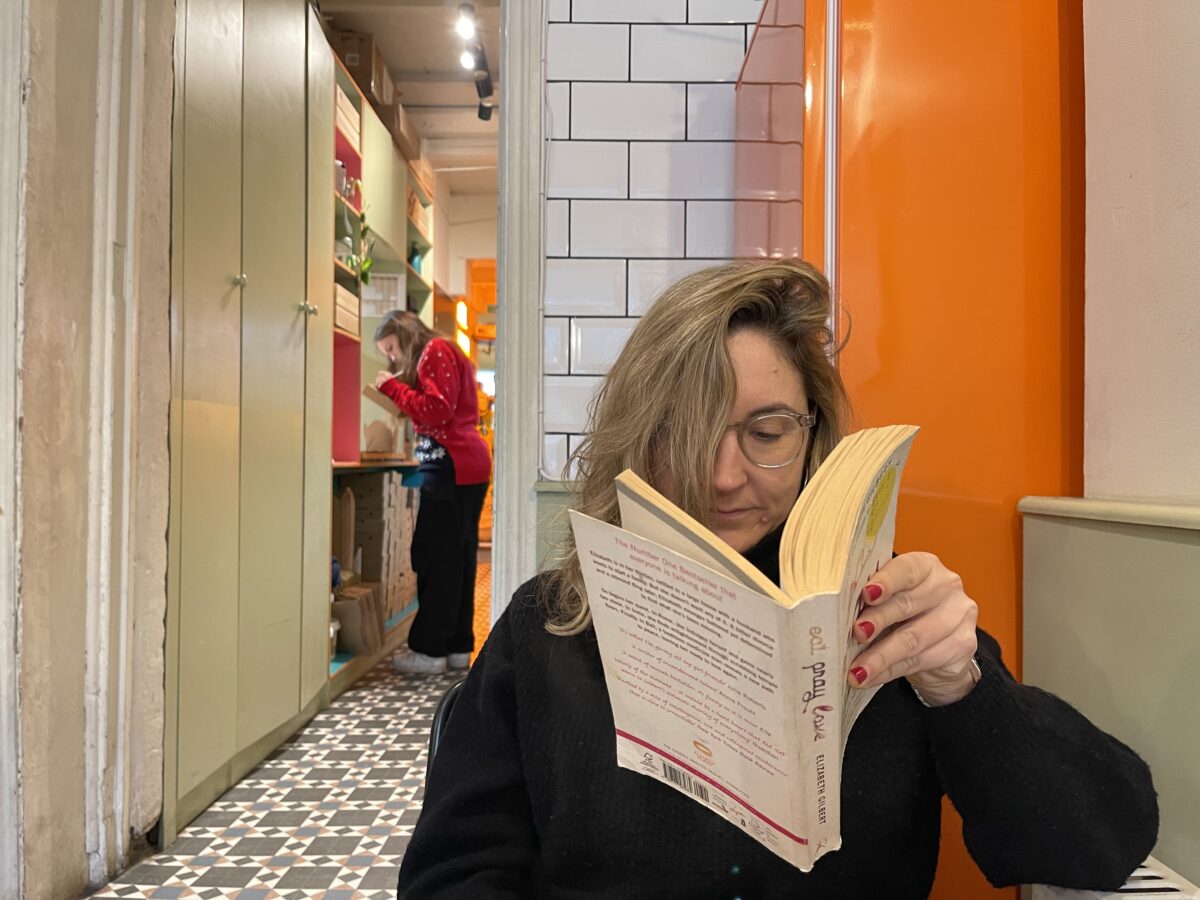
EAT PRAY LOVE by Elizabeth Gilbert

I don’t know why this bestseller has such a terrible reputation. I quite enjoyed it. It is a memoir of a woman whose marriage, and then affair that ended that marriage, both explode spectacularly. She decides to heal herself by going on a year long holiday. What is really impressive about this is she sells a book proposal about this and so funds it upfront.

It is maybe a little obvious that this book was written off the back of a book proposal, and not one for a very sophisticated audience. She plans to travel to three countries: Italy, to explore pleasure: India, to explore religion; and Indonesia to explore balance (?). I’m amazed in 2006 someone could with a straight-face describe whole countries as representing things, but here we are, and it was a bestseller. Let us just be grateful she did not get around to Africa.

I was very interested by her time in the Indian ashram, and her sincere attempts to meditate for hours every day. I try for ten minutes and that is tough enough. I liked this as an explanation of silent retreats:

The Yogic sages say that all the pain of a human life is caused by words, as is all the joy. We create words to define our experience and those words bring attendance emotions that jerk us around like dogs on a leash. We get seduced by our own mantras (I’m a failure . . . I’m lonely . . . I’m a failure . . I’m lonely . . ) and we become monuments to them. To stop talking for a while, then, is to attempt to strip away the power of words, to stop choking ourselves with words, to liberate ourselves from our suffocating mantras.

Now I just need to find a way to fund my holidays with book proposals.

THE GRASS ARENA by John Healy

Sometimes it feels as if every addict has written a memoir, like it’s one of the twelve steps or something.

I was recently noting how very many there were, and how similar. Here’s the book that shows I was wrong (first time for everything). It also shows something we often forget: how incredibly stitched up the book world is by people who were able to graduate high school.

THE GRASS ARENA is by a man who had an exceedingly tough childhood, became an alcoholic, and spent fifteen years homeless. It makes all sorts of more famous books on alcoholism look like a holiday camp, because they are all written by people who, at the end of the day, had parents in the suburbs to go back to. I have never read an account of what it is to be an addict without a safety net.

The grass arena is public parks, mostly round Camden. This is very much a book of north London. He tells about his daily life. He wakes up blacked out most days, and begins again from scratch to find enough money to drink. Let me give you a sample:

George and Ernie came back with a bag full of chicken bones. They’ve been down the dustbins again, back of the restaurants. Everybody welcome to lunch. Yeah, we’re all going to catch some horrible unspeakable disease. Not today perhaps. But time is on the dustbins’ side

He also tells us about his fellow drunks (not his friends, as he emphasizes: there are no friends in that community):

Alfie used to drink with a guy called Fingers Knox but Fingers got himself killed when he fell from the top to the bottom of the escalator in the tube. Poor old Fingers, that was some drop – he was a good beggar – lost most of the tops of the fingers of his right hand to the frost, a few winters back. He was a middle-aged Jock, used to travel out on the last tube to Edgeware every night to a skipper. He’d beg all the way on the tube going out, get a bottle next morning and beg his way back to the park. He was never without a drink. He used to take fits and get mugged often. He got nicked one time and the computer or something showed he was a deserter from the army in 1939! . . He used to say it was sad to have to creep and crouch and slink next morning after drink and that was why he always done a bit of late night begging. . . He had style. He would not keep jumping up at everyone that went past. He would wait. Then when he sensed the best beg, he’d put on his begging smile, beam in. Nine times out of ten it would be a fiver touch.

I find this very touching somehow, that this is what is left to posterity of Fingers Knox. The author eventually goes to jail for a long period, gets clean, and is eventually rescued from alcoholism by chess. Yes, you read that right. Someone teaches him chess and it transforms his life. He becomes a professional chess player. And then a yogi. What a man! What a life!

ORIGINAL SINS by Matt Rowland Hill

The field of memoirs on drug addiction is a crowded one. Well done to this guy for getting his book written and published, but I’ve got to be honest and say it’s a story that’s been told before. Not that that makes his suffering any the less real: the stealing, the betraying, the bulging veins, but it’s hard going when it’s been done before. Like I am always impressed by people who sit down and decide they are going to write about the first world war. Check it out: ALL QUIET ON THE WESTERN FRONT already exists. Best to retreat from that field in good order.