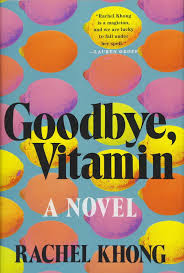
GOODBYE VITAMIN by Rachel Khong

I was okay with this book.  It is about a 30 year old who returns to look after her father who is ill as her own life is falling apart.  It’s sweet and comic, despite the relatively dark subject matter, and other reviewers have liked it, but for me it was a bit meh.  

I think it was hurt  by the fact that I read it immediately after Andrew Sean Greer’s Pulitzer-winning LESS, which is in many ways quite similar but somehow much, much better.  It’s like how you would be impressed by a skater scoring 8 until you see the skater scoring 10.  

And there are some true 10/10 lines.  Try this, on her ex-boyfriend, who left her for someone else, someone he then more or less immediately married: “You know what else is unfair, about Joel? That I loosened the jar lid, so somebody else could open him up.” 

No disrespect then to Rachel Khong: it’s hard to get a first novel published, and harder to get it reviewed well in the New York Times.  Winning the Pulitzer can happen next.

TALENTED MR RIPLEY by Patricia Highsmith

I read this book on a first generation Kindle in a tent in Yellowstone.  It is absorbing enough to help me forget the cold and the mysterious interior condensation.  It’s  a lot gayer than the movie, as far as I remember.  Written in 1955, it remains shockingly sharp and contemporary feeling.  It also very much checks its morality at the door; I’m not sure I’ve ever read a book that was so judgment free. It tells the story of a man who murders his way into a substantial fortune, and gets away with it.

It manages the difficult trick of making you root for the sociopath, not least because the victims are all people who inherited their money.  It’s hard to feel they deserve the money, so you don’t care when they lose it.  At least they don’t deserve it anywhere near as much as the sociopath, who is at least willing to kill for it.  The best part is that not only does he not get caught, he doesn’t suffer any guilt over what he’s done either.  A model for all of us.

Bonus important author biographical information:  Apparently Patricia Highsmith was a miserable misanthrope, who once bought a head of lettuce with a hundred snails on it in her handbag to a cocktail party, saying they were her companions for the evening.  Amazing. 

LESS by Andrew Sean Greer

It’s not every day a book gets passionately recommended in the Whatsapp group of my high school friends.  But then LESS is not an everyday book.  Sometimes books just deserve to win all this prizes.  This is one, and it has.  Or at least the Pulitzer, which is all you need.  It’s a coming of age story, and the age that’s coming is middle age. 

It tells the story of Arthur Less, a writer who is approaching a difficult round-number birthday, and is working to get over the end of his relationship with a much younger man.  
The story is sweet, and sad, and very funny.  Arthur is a lovely creation  – on the phone (“frenetically dialing like a man decoding a bomb”); leaving a cab (“fumbling the tip and leaping out as from a hostage situation”); letting his mind wonder during a talk (” . . . feels his mind drifting away like a spaceman from an airlock, off into the asteroid belt of his own concerns.”)  But everything in the book is beautifully conceived.  Here, randomly, camels:

What does the camel love?  I would guess nothing in the world.  Not the sane that scours her, or the sun that bakes her, or the water she drinks like a teetotaller.  Not sitting down, blinking her lashes like a starlet.  Not standing up, moaning in indignant fury as she manages her adolescent limbs.  Not her fellow camels, to whom she shows the disdain of an heiress forced to fly coach.  Not the humans who have enslaved her.  Not the oceanic monotony of the dunes.  No the flavourless grass she chews, then chews again, in a sullen struggle of digestion.  Not the hellish day.  Not the heavenly night.  Not sunset. Not sunrise. Not the sun or the moon or the stars.  And surely not the heavy American, a few pounds overweight but not bad for his age . . . 

It’s not just funny though, but also wise.  Silly situations tend lyrical. Here for example is Arthur in the airport, frustrated that once again he has failed to get back his VAT despite having filled out all the forms:

How awful for the string of inequities to be brought out in his mind, that useless rosary, so he can finger again those memories; the toy phone his sister received while he got nothing, the B in chemistry because his exam handwriting was poor, the idiot rich kid who got into Yale instead of him,the men who chose hustlers and fools over innocent Less, all the way up to his publisher’s polite refusal of his latest novel and his exclusion from any list of best writers under thirty, under forty, under fifty—they make no lists above that.  The regret of Robert.  The agony of Freddy.  His brain sits before its cash register again, charging him for old shames as if he has not paid before.  He tries but cannot let it go.  It is not the money, he tells himself, but the principle.  He has don’t everything right, and they have conned him once again.  It is not the money.  And then, after he passes Vuitton, Prada, and clothing brands based on various liquors and cigarettes, he admits it to himself at last: It is indeed, the money. 

SPOILER ALERT It ends happily, in a way that involves the much younger man.  I don’t think I could have handled it for it to end in any other way.  You can always tell I like a book when my blog post is nothing  but extracts.  Let’s end with him with the much younger man:

He kisses – how do I explain it?  Like someone in love.  Like he has nothing to lose.  Like someone who has just learned a foreign language and can only use the present tense and only the second person.  Only now, only you.

A SPORT AND A PASTIME by James Salter

I don’t want to be the sort of person who is so woke they can’t enjoy a great book.  Thus, I feel rather guilty to say I could not enjoy this beautifully written novel as much as I wanted to because YOU JUST DON’T ENCOURAGE TEENAGE GIRLS TO RELY ON THE RHYTHM METHOD.  That it is the 1960s is no excuse, especially when you are a thiry year old man with family money and she is an eighteen year old shop girl from a small town.

That said, I do understand why it is considered a modern classic, and it does include the second most poetic description of anal sex I’ve ever read.  (You will learn more than you want to about the first when I get round to THE LESSER BOHEMIANS by Eimar McBride).   Here is a taste, but just a small one as this is a family blog:  

In the morning it is calm.  He awakens as if a fever has passed.  Europe has returned to its real proportions.  The immortal cities swim in sunlight.  The great rivers flow.  His prick is large and her hand moves to it as soon as her eyes open.  He searches his clothing for the crumpled, leaden tube.  He hands it to her.  She looks at him impassively.  He kicks the covers away as she unscrews the cap.  She begins to spread it on.  The coolness makes him jump.  Afterwards she rolls over and in the full daylight he slowly inserts his gleaming declaration.  

One of the stranger and more wonderful things about this blog is that it is written not from the perspective of the main couple, whose love story this is, but from that of his friend, and as he assures us: “I am not telling the truth about Dean.  I am creating him out of my own inadequacies, you must always remember that.” It’s thus less a story of something that happened and more a story of someone’s painful imaginings of other people’s lives.  This makes it a more complicated book than it at first seems.  For example, here they are in a car.  

In the great car that exists for me in dreams, like the Flying Dutchman, like Roland’s horn, that ghosts along the empty roads of France, its headlights faded, its elegance a little shabby; in that blue Delage with doors that open backwards, deep in the seats they drive towards home.  The villages are fading, the rivers turning dark.  She undoes his clothing and brings forth his prick, erect, pale as a heron in the dusk, both of them looking ahead at the road like any couple.  

I just chose that snippet specifically for the heron bit of course.  There are so many beautifully observed bits, and such carefully constructed sentences, there was almost too much to admire in this book. There is just such an impressive amount of work in it it almost got hard to read; I imagine Salter at his desk for years, to come up with these 200 pages.  Here he is on seeing some people on a deserted street on a Sunday

Unexpectedly, like a band of survivors, there is a crowd, all decently dressed, just leaving church.

Or on a train:

There’s a comfortable feeling of delivering myself into the care of those who run these great, somnolent trains, through the clear glass of which people are staring, drained, as quiet as invalids.

And yet somehow I can’t say I enjoyed this book.  It was just so creepy, his clear plan to ditch her, and to definitely ditch her as soon as she got pregnant.  His not using contraception (though he clearly tells her, when she asks, that it is available in America), and her calm because ‘eight days before and eight days after’ you are fine makes your skin crawl.  The story is detailed and observant when it is about the narrator, and his sexual inadequacies, and about the man, with all his sexual super-abundance, but when it is about the girl – “good-looking, not too intelligent perhaps” – as he casually describes her – all that ends abruptly.   I’m trying to get past it, but it’s hard.  I’ll do it though. If you ruled out all the books where women were objects you could hardly read the canon, and I don’t care enough about my gender to give up the world’s great books.  

HOW TO KILL A MOCKINGBIRD by Harper Lee

From the very first lines this book is like: BOOM.  
Really, great books are a miracle.  They have such a sense of inevitability about them – as if they had to exist, and exist in exactly this way – that its hard to imagine that someone actually had to sit down and right them.  Particularly interesting is the fact that this was Harper Lee’s first book.  She was at work on a second one, and when this was accepted by an agent she apparently somehow froze on the second; and then when this turned into a major success (and success is putting it mildly – it’s possibly the best selling book of the 20th century) then it was really all over for her.  She didn’t publish anything else for fifty years.  The dreaded second album problem on steroids.  
Anyway, this first album is more than most people manage in a lifetime.  It tells the story of the children of a small town lawyer in Alabama who runs into trouble with his neighbours when he defends a black man against the charge of raping a white woman.  The man is clearly innocent, but he is found guilty in any case.  This sounds like it must be a serious story of discrimination, which it is, but at the same time it is a comic story of growing up, and a portrait of a small town that is both loving and damning.

What I most enjoyed was the subtly comic tone.  When I really like a book, I tend to overquote on my blog.  Here we go: 

Maycomb was an old town, but it was a tired old town when I first knew it. In rainy weather the streets turned to red slop; grass grew on the sidewalks, the courthouse sagged in the square. Somehow, it was hotter then: a black dog suffered on a summer’s day; bony mules hitched to Hoover carts flicked flied in the sweltering shade of the live oaks on the square. Men’s stiff collars wilted by nine in the morning. Ladies bathed before noon, after their three-o’clock naps, and by night fall were like soft teacakes with frostings of sweat and sweet talcum

Teacakes with frostings of sweat and sweet talcum!  I will never look at perspiring women the same way again.  And here’s the family doctor who “had brought Jem and me into the world, had led us through every childhood disease known to man including the time Jem fell out of the tree house, and he had never lost our friendship. Dr. Reynolds said that if we were boil-prone things would have been different”
The children are a girl, Scout, and a boy, Jem.  Here is Jem telling Scout to not get so angry at her aunt, as it bothers their father (who they call by his first name, Atticus):

“You know she’s not used to girls,” said Jem, “leastways, not girls like you. She’s trying to make you a lady. Can’t you take up sewin’ or somethin’?” “Hell no. She doesn’t like me, that’s all there is to it, and I don’t care. It was her callin’ Walter Cunningham trash that got me goin’, Jem, not what she said about being a problem to Atticus. We got that all straight one time, I asked him if I was a problem and he said not much of one, at most one that he could always figure out, and not to worry my head a second about botherin’ him.

Enjoyable piece of literary trivia: the character Dill in the book, who is Scout’s best friend, was based on Truman Capote, who in real life was Harper Lee’s next door neighbour in childhood.  Monroeville Alabama great novelist per capita numbers are way high


NEWLYWEDS by Nell Freudenberger

It’s really important to have a plan on what you are going to read on vacation.  I had no plan and ran out of books.  Thus this, found in one of these free book exchanges in hotels.  It is about a mail order bride from Bangaldesh and her early days in the US.  It was reasonably okay, though I wasn’t too sure what point it was trying to make.  Broadly, she realizes she is in love with her old Bangladeshi boyfriend, but sticks it out with the (in my mind suspiciously) okayish American so her parents can move to the First World.  I guess its a story of filial rather than marital love.  It’s a good thing I have a blog because I left it in Oregon and have already almost forgotten all about it

THE AWAKENING by Kate Chopin

This book tells the story of a woman who is tired of her marriage and the life it has given her.  Written in 1899, it’s reads remarkably fresh and modern.  It is apparently – though I had never heard of it – widely regarded as an American classic.  While really an excellent book, that caused a furore when first published (apparently female self-discovery is “trite and sordid”), it was then forgotten for the next sixty years until feminist circles picked it up.  Patriarchy doesn’t play when it comes to pushing things out of print.

The main character is on holiday at the beach in Louisiana with her husband and children when she meets a man and finds herself growing interested in him.  She doesn’t actually cheat, but this interest slowly has her re-examining what she is doing, moving out of her husband’s house, and separating herself from her children whom, enjoyably shockingly, she feels pretty average about.  Kate Chopin knew something about having children, having had six herself in just eight years.  At some point you have to wonder at what point pregnancy tips into spousal abuse.  (As a side point, it’s interesting to note that in all countries without exception, birth rates decline as female empowerment goes up.  Makes you wonder how women in the past really felt about their children, especially after the third or fourth.)

It’s a book I strongly recommend, reaching out across over a hundred years to speak truths we still recognize about love and boredom.  Chopin is a remarkable writer, and shockingly contemporary.  Enjoy this, not from the book itself, but from her diary, which gives you a sense of her style:

I must tell you [her diary] a discovery I have made – the art of making oneself agreeable in conversation. Strange as it may appear it is not necessary to possess the faculty of speech; dumb persons, provided they be not deaf, can practice it as well as the most voluble. All required of you is to have control over the muscles of your face – to look pleased and chagrined…interested and entertained. Lead your antagonist to talk about himself – he will not enter reluctantly upon the subject I assure you – and twenty to one – he will report you as one of the most entertaining and intelligent persons

ADVENTURES OF HUCKLEBERRY FINN by Mark Twain

I can’t think how I have never got round to reading this before.  I was inspired by reading in the Introduction to something else (tip: Introductions are a great source for reading recommendations) that Huckleberry Finn is widely regarded as the true beginning of American literature.  Indeed, it is a triumph of narrative voice.  Huckleberry, the narrator, just leaps off the page.  It’s strange really, as this was for Twain a sequel, and Huckleberry a secondary character to Tom Sawyer, so it’s odd that it is this book, and not the other, that is his masterpiece.

The book is about a young boy who runs away from his abusive father along with an escaping slave by floating down the Missisippi on a raft.  Written that way, it sounds rather bleak, but somehow it is comic.  After all, as Huck says:  

Other places do seem so cramped up and smothery, but a raft don’t.  You feel mighty free and easy and comfortable on a raft.  

The story is full of boys-own still hijinks, that do get a little wearing, but it is redeemed by lovely little passages like this:

When I got there it was all still and Sunday-like, and hot and sunshiny; the hands was gone to the fields; and there was them kind of faint dronings of bugs and flies in the air that makes it seem so lonesome and like everybody’s dead and gone; and if a breeze fans along and quivers the leaves it makes you feel mournful, because you feel like it’s spirits whispering—spirits that’s been dead ever so many years—and you always think they’re talking about YOU. As a general thing it makes a body wish HE was dead, too, and done with it all.

It’s also always fun. Take this description of an undertaker:

When the place was packed full the undertaker he slid around in his black gloves with his softy soothering ways, putting on the last touches, and getting people and things all ship-shape and comfortable, and making no more sound than a cat. He never spoke; he moved people around, he squeezed in late ones, he opened up passageways, and done it with nods, and signs with his hands. Then he took his place over against the wall. He was the softest, glidingest, stealthiest man I ever see; and there warn’t no more smile to him than there is to a ham.

Huck’s friendship with the slave, Jim, is the warm heart of this novel.  What is very difficult for a modern reader is how Huck struggles with this friendship:

He was saying how the first thing he would do when he got to a free State he would go to saving up money and never spend a single cent, and when he got enough he would buy his wife, which was owned on a farm close to where Miss Watson lived; and then they would both work to buy the two children, and if their master wouldn’t sell them, they’d get an Ab’litionist to go and steal them. It most froze me to hear such talk. He wouldn’t ever dared to talk such talk in his life before. Just see what a difference it made in him the minute he judged he was about free. It was according to the old saying, “Give a nigger an inch and he’ll take an ell.” Thinks I, this is what comes of my not thinking. Here was this nigger, which I had as good as helped to run away, coming right out flat-footed and saying he would steal his children—children that belonged to a man I didn’t even know; a man that hadn’t ever done me no harm.


Huck never turns Jim in, and it is strange and sobering to see how often he considers doing so.  Twain grew up in the geography and time period of this novel – this book joins many others in being a masterpiece made out a childhood – so perhaps this just shows how white people really did think about this topic then, and it is a good challenge to us to hear about it. 

SOMETHING IN THE WATER by Catherine Steadman

I rarely read thrillers, but I was on  holiday and desperate.  Also I’m getting old and my standards are lowering.  I recall I noted on this blog the first book I ever read on an e-reader, and I should note that this is the first book I ever read entirely on a phone.  It was a surprisingly comfortable experience.  I read most of it while sick with a cold in a hotel room in Napa.  Then I snatched victory from defeat by going out to drink Californian wine on top of my medication.

It was easy to get through most of it in a marathon session, as it is a quick and compelling page turner.  It’s written by an actress (from Downton Abbey) and I take my hat off to her, because I thinking writing more-ish commercial fiction must be much harder than it looks. Take this fabulous opening, of the first chapter (titled, amazingly, ‘The Grave’): 

Have you ever wondered how long it takes to dig a grave?  Wonder no longer.  It takes an age.  However long you think it takes, double that.

The story begins with a  couple on honeymoon finding some papers in the sea outside their hotel, and quickly descends to theft and murder.  I won’t tell you anymore, as it’s hard not to immediately start spoilers, but let’s just say GONE GIRL is an influence, though not in the way you think.

I’ll close with the book’s opening quotation, which is surprisingly high brow, and very excellent. 

If a victory is told in detail, one can no longer distinguish it from a defeat. 

I love that. It speaks to how hard it is to get anything done, not least, I suspect, writing a book that made it into Reese Witherspoon’s book club.  It’s not Oprah, but I’d still call it victory.

THE MALAY ARCHIPELAGO by Alfred Russel Wallace

I always used to feel rather sorry for Wallace, who always struck me as a rather tragic case of missing the boat.  He  was a nineteenth century naturalist that had the idea of evolution at the same time as Darwin, and wrote to Darwin (a much wealthier, older man)  to share it with him, which prompted Darwin to hurry up and publish his own existing paper on the idea quickly himself. Thus, Darwin ends up the discoverer of evolution; he is the famous one; the adjective is Darwinian and not Wallacian. What we learn from this, is don’t respect your elders.  Lesson aside, after reading this book I no longer feel sorry for Wallace.  He had an amazing life and enjoyed himself to the max. 

This book is the account of his eight years expedition around Singapore, Malaysia, Indonesia and East Timor in the 1850s.  In summary, it was off the hook, and he loved it, mystery fevers and diarrhoea aside.  Here he is, finding a place to keep the alcohol for his insects, and a place for himself to sleep:

. . . I thought it safer to leave my case of arrack securely placed in the fork of a tree. To prevent the natives from drinking it, I let several of them see me put in a number of snakes and lizards; but I rather think this did not prevent them from tasting it.  We were accommodated here in the verandah of the large house, in which were serveral great baskets of dried human heads, the trophies of past generations of head hunters  . .  I slept very comfortably with half a dozen smoked dried human skulls suspended over my head

Heads aside, I enjoyed his various encounters with local communities, which were surprisingly respectful for his period.  Here he is at dinner one night:

I took my evening meal in the midst of a circle of about a hundred spectators anxiously observing every movement and critising every mouthful, my thoughts involuntarily recurred to the lions at feeding time.  Like those noble animals, I too was used to it, and did not affect my appetite.  . . I. . turned showman myself, and exhibited the shadow of a dog’s head eating, which pleased them so much that all the village in succession came to see it.  The ’rabbit on the wall’ does not do in Borneo, as there is no animal it resembles.

There are some super dodgy sections whether or not some races are superior to others, and he ties himself into knots trying to prove that forced labour was good for the locals, but this is as nothing compared to your hardcore Victorians.  It’s shocking to be reminded how very long ago the 1850s were, and how much intellectual ground there was still to cover:

Poets and moralists, judging from our English trees and fruits, have thought that small fruits always grew on lofty trees, so that their fall should be harmless to man, while the large ones trailed on the ground. Two of the largest and heaviest fruits known, however, the Brazil-nut fruit (Bertholletia) and durion, grow on lofty forest trees, from which they fall as soon as they are ripe, and often wound or kill the native inhabitants. From this we may learn two things: first, not to draw general conclusions from a very partial view of nature, and secondly, that trees and fruits, no less than the varied productions of the animal kingdom, do not appear to be organized with exclusive reference to the use and convenience of man

It’s so different a world view it’s hard to imagine.  Though for sure we all still act as if the planet existence for our immediate convenience. 

Also fun, in a boring way, where his long lists of insects he collected, which he thinks are fantastically interesting, and clearly thinks we will be debating him on.  It’s compelling how he loves the natural world, and his excitement at what he finds.  He is particularly struck by the beauty of the orgutangs, and how human-like they are, and is thus especially delighted when he manages to kill like 5 adults and 3 children.  He often elaborates on how lovely a bird is  before telling us how extra thrilled he is to have shot a large number of them.  He collected over 100,000 specimens, including 5000 new to science.  And he had an amazing time doing it.  Not too bad a life, after all, even if he doesn’t get to have his surname an adjective.