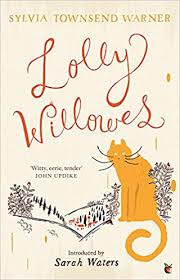
In desperation I did a line-by-line review of this blog post at BookRiot, looking for things to read, and bought a lot of second-hand books on Amazon. This one is a real find.
Set in the 1920s, it tells the story of an unmarried woman who after her father’s death moves in with her brother’s family, moving from the countryside into London. She lives with them for some twenty years, until suddenly, after a visit to a florist shop where she is utterly beguiled by some foliage (yes, really) she insists on moving back to the countryside. It is a sort of terrifying story, because once back in the country she realizes how very unhappy she has been in the city; and it makes you think how easily you can let the decades slip by without noticing how you really feel.
She loves the landscape, but more than that, she loves being the master of her own time. In London she was ‘busy’ with the family; in the country she is not busy at all, though at first she tries to be, reading the guide book and going on walks to landmarks. As she puts it:
She knew in her heart that she was no really enjoying this sort of thing, but the habit of useless activity was too strong to be snapped by a change of scene.
Chilling. I am sure much of most of our lives can be described as useless activity.
In any case, she is much happier, rambling, eating meals at odd times, and so on. Then one night she finds a kitten in her rooms, and while she is playing with it it scratches her, drawing blood. Her heart pounds, and she makes a sudden realization:
She, Laura Willowes, In England, in the year 1922, had entered into a compact with the Devil.
To which I can only say: ?
Indeed, the book has taken a turn. We learn that her enjoyment of the night, and the wild places; the fact that she can turn the milk sour with her mind; all this is due to the fact that she is indeed being pursued by the Devil. She is delighted, meets the local coven, communes with the night, etc. It sounds crazy, and it is, but is has its own sort of internal logic.
When she does eventually meet Satan, we sort of understand her embrace of him as having to do with what today we would boringly call gender issues. As she puts it to him, speaking of her relatives (who she is very fond of):
They say: “Dear Lolly! What shall we give her for her birthday this year? Perhaps a hot water bottle. Or what about a nice black scarf? . .. But you say: “Come here, my little bird! I will give you the dangerous black night to stretch your wings in, and poisonous berries to feed on, and a nest made of bones and thorns, perched high up in danger where no one can climb to it.” . . .
. . . One doesn’t become a witch to run around being harmful, or to run around being helpful either, a district visitor on a broomstick. It’s to escape all that – to have a life of one’s own, not an existence doled out to you by others, charitable refuse of their thoughts, so many ounces of stale bread of life a day . ..
She wants to avoid the fate of most women, who are, despite their endless domestic activities, fundamentally unimportant.
Respectable countrywomen keep their grave-clothes in a corner of the chest of drawers, hidden away, and when they want a little comfort they go and look at them, and think that once more, at any rate, they will be worth dressing with care
Given the date (it’s funny to think the author didn’t even have the right to vote) I understand this gender lens on the topic. But for me, who has had privilege of suffrage from birth, what I more took from the book is the importance of not leading your life by other peoples’ standards – that is, the importance of your own daily freedom.
I also took from it a profound admiration for the writer as a writer. Enjoy this, on her mother who was kind of neglectful, in a gentle way:
During the last few years of her life Mrs Willowes grew continually more skilled in evading responsibilities, and her death seemed but the final perfected expression of this skill. It was as if she had said, yawning a delicate cat’s yawn, ‘I think I will go to my grave now,’ and had left the room, her white shawl trailing behind her.
Or this maid:
The maid who brought her morning tea. . . had an experienced look; when she drew back the curtains she looked out upon the day with no curiosity. She had seen it all already
Or her rather religious sister-in-law
Laura . . . had commented upon the beautiful orderliness with which Caroline’s body linen was arranged therein. ‘We have our example,’ said Caroline. ‘The grave-clothes were folded in the tomb. . ..
The introduction calls Townsend ‘one of the most shamefully under-read great British authors of the last hundred years’ and I am shocked I never heard of her before; huge thanks to BookRiot for sorting me out.