THE BIG ROCK CANDY MOUNTAIN by Wallace Stegner

Well here are some pretty serious #daddyissues.  This book tells the story of a couple who get married, have two children, and move restlessly across the Midwest looking to strike it big.  At least the father is looking to strike it big.  The mother is just hanging on.

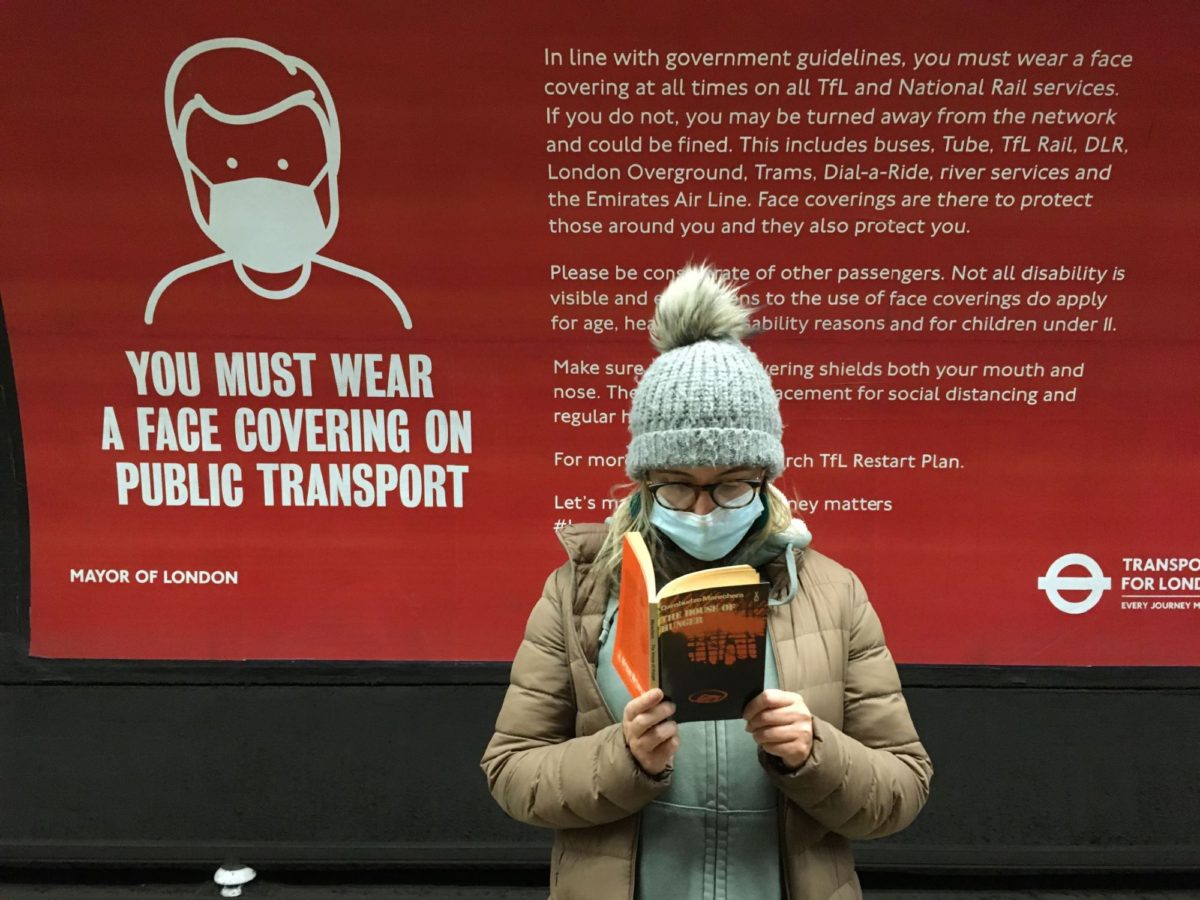
It’s a broad sweep of middle America across decades, involving possum-hunting and gold-panning and bootlegging and the Spanish Flu.   (This was remarkably like todays’ COVID.  They went on lockdown, they wear masks, it made me wonder if really medical science has not come on that far after all)

The book is so jam packed with incident, some of it so random, that I started to suspect it must be based on  real life.  I also wondered this because it was so completely judgemental towards the father character.   This dad came from poverty, and pulled himself up into wealth.  He couldn’t stand the idea that he was going to be trapped in a $100/month job because of his lack of education and was always looking for the next big break. I found this kind of inspirational, like he was a class warrior.   His youngest son doesn’t take it that way, and is horrified by his bootlegging (but not so horrified that he doesn’t take that sweet moonshine money to pay for his law degree). 

I learn from the Introduction that indeed this is the story of Stegner’s own family.  Sadly his mother, brother and father all died within three years of each other, and it was then he decided to write about them.  This casts the book in a different light for me.  I see what it is, his effort to record and remember them, to create a monument to their messy lives.   I can’t imagine what it must be like to be the only one who remembers your childhood, though I guess that if I am lucky enough to live to a great old age I will find that out.    I wonder if I’ll want to write about it, when its only me left. 

WHEN YOU ARE ENGULFED IN FLAMES by David Sedaris

There was a period in 2011, not coincidentally not a great time in my personal life, when I read a lot of David Sedaris.  And by a lot, I mean it all, and mostly in the early hours of the morning. 

Recently  I googled for authors ‘like Sedaris,’ and was surprised  by how few options there were.. I gave the options a go (Crossley, Burroughs, Rakhoff) and can report that the options are even fewer than Google suggested, in fact essentially nil.  No one is writing the comic personal essay like Sedaris.  And by no one, I mean no one.  Really, I find this remarkable.  Everyone has a personal life.  Most people have a sense of humour.  It’s incredible that Sedaris has, at least in my opnion, not one truly viable competitor.

I started a re-read of him, to try and figure out what he is doing.  My blog tells me this is the third time for FLAMES.  And three times round, I still can’t tell exactly what it is he is doing so well.  Here he is on glasses:

Today these frames sound ridiculous, but back then they were actually quite stylish.  Time is cruel to everything but seems to have singled out eyeglasses for special punishment.  What looks good now is guaranteed to embarrass you twenty years down the line, which is, of course, the whole problem with fashion.

And on smoking:

As with pot, it was astonishing how quickly I took to cigarettes. It was as if my life was a play, and the prop mistress had finally shown up.  Suddenly there were packs to unwrap, matches to strike, ashtrays to fill, and then empty. 

I tried to map out a couple of the essays, and my theory is the success is the apparent ease: conversational and yet so artful.  In later years he has got a bit sappy, one has to hear about his feelings, and in particular his feelings about his father, but at his best: he’s quite alone in his medium. 

NOTHING TO SEE HERE by Kevin Wilson

A bizarre tale of income inequality and spontaneous human combustion, NOTHING TO SEE HERE is so good it kind of depressed me.

 It tells the story of a young girl, Lillian, from a poor background who works very hard to get a scholarship to a fancy boarding school:

I didn’t know the school was just some ribbon rich girls obtained on their way to a destined future. . . . . I wasn’t destined for greatness, I knew this.  But I was figuring out how to steal it from someone stupid enough to relax their grip on it.

This is in the first few pages.  Already at this stage I had a sinking feeling in my stomach about how magically good this one was going to be. 

At this school, she really, really likes her roommate. Here is part of one of their early conversations:

“. . I want to be so important that if I fuck up, I’ll never get punished.”  She looked psychotic as she said this; I wanted to make out with her.

. . .“I think we’ll be friends,” she said. “I hope so, at least.”

“God,” I said, trying to keep my whole body from convulsing.  “I hope so, too.”

Years later, when Lillian has lost her way and spends most of her time smoking pot in her mother’s attic, this friend asks her to nanny two children who have behaviour issues.  The behaviour issues are they burst into flames when they are upset.  The friend is married to a Senator, Jasper Roberts, and is fabulously wealthy.  Here he is on TV:

Jasper was on C-SPAN, smiling, listening thoughtfully, nodding, so much nodding, like he understood every fucking thing that had ever happened in the entire world.  They would cut to different senators who were on the committee and it was like a practical joke because they all looked exactly the same. 

Part of the weird power of this book is the dreadful acceptance of how the world is; that is, that the rich are rich and will always be rich, and the poor are staying poor.  Eventually Lillian comes to love the children, and there is a degree of redemption in this.  Here is her fantasy of reunion with her mother that never happened:

. . .  And she would hug me and it wouldn’t be weird. It would be like the way somebody hugs another person. And the entirety of my life, everything that had come before, would disappear. And things would be so much better.

In the end though it’s really a sort of bleak novel.  Lillian find some sort of hopefulness, but it’s a narrow, conditional thing, in the middle of world that is totally unfair and will stay that way

NIGHT BOAT TO TANGIER by Kevin Barry

It’s rare I loathe a book, but here we are.  It has many good reviews, and was longlisted for the Booker, so I am the minority in this view.  But really.  First of all, it’s all very lyrical.  This is always annoying.  Try how this potentially good piece of dialogue is ruined

Personally speaking, Maurice? My arse isn’t right since the octopus we ate in Malaga.
Is it saying hello to you, Charlie?
It is, yeah. And of course the octopus wasn’t the worst of Malaga.
…. They look into the distance. They send up their sighs. Their talk is a shield against feeling

Second of all, it’s all about tough men, and it pretends like it is supposed to show how terrible the consequences of violence are.  Meanwhile clearly this book is all about the romance of violence.  I don’t need to google the author to find out the author is a man.  It’s almost always men who like to spend their novels thinking about violence, and I don’t think we need to think that hard to find out why that might not be so interesting for women.  I just don’t need to live in their fantasy

CARRIE by Steven King

I picked up CARRIE because I read Steven King’s autobiography, and was curious to see what the book that changed his life was like.

It was his first novel,and he almost fainted when the publisher offered him $400K for it, because he was barely paying his bills at the time.  He’d actually thrown the first draft in the bin, and it only made it to the publisher at all because his wife fished it out and insisted he go on with it.  To read his autobiography, you’d think by this stage he was on the verge of past it, about to sink into a life of low income jobs, nearly missing his potential.  In reading the back cover I discover he was actually only TWENTY-SIX.  For god’s sake, Steven, I don’t think it’s even possible to waste your life already when you’re just in your twenties. It’s only in your forties you start looking down that particular barrel.  Unless of course you commit a murder and get caught.  I was listening to a podcast recently about a man who killed someone at 15, and is getting out now, 40 years later.  First thing he is going to do is have an omelette, he said.  Second thing is go to his parents graves to apologize for throwing his life away. 

It’s possible this post is going off course.  Back to CARRIE.  What I found surprising was how straightforward it was, how little plot it had, and how little real ‘horror’ was involved.  It’s essentially a “worm turns” story, though in this case the worm devours its hometown after turning.  For those who don’t know SPOILER ALERT the book is about a girl who is badly bullied at school and ends up blowing up her prom with her telekentic powers.

Apparently when this was written, horror was very much about shadowy alleys and old parchments, so it was revolutionary in its ordinary setting and conventional protagonists.  It no longer feels revolutionary, but is still a solid, engaging read, and captures very well what it was to be a teenage girl (not that surprising because Steven King you were SO YOUNG WHEN YOU WROTE IT I DON’T WANT TO HEAR ABOUT HOW YOU FELT YOU WERE WASTING YOUR LIFE.)

RUNNING WITH SCISSORS by Augusten Burroughs

Here is a book about what happens when there are not enough social workers.  Augusten Burroughs parents are getting a divorce:

My father grew hostile and remote .  . . And my mother began to go crazy.  Not crazy in a let’s paint the kitchen red! sort of way.  But crazy in a gas oven, toothpaste sandwich, I am God sort of way.  Gone were the days when she would stand on the deck lighting lemon-scented candles without then having to eat the wax. 

She eventually give over her son to live with her psychiatrist, Dr Finch, who believes children over the age of thirteen should be completely free.  He also believes that he direction of his poop in the toilet bowl contains messages from god, as does choosing Bible verses at random.  His oldest daughter preserves his poops on an outdoor table, and checks the Bible for him for all sorts of questions.  The other children, some biological, some not, are left quite free, to knock sunroofs into the ceiling (by just making a hole), to eat dog food, and to get raped by adults.  Apparently when children are completely unsupervised it does not take long for predatory types to recognize this as an opportunity. 

At 14 he has a relationship with a 33 year old man that he believes is loving.  So too does the 33 year old, who makes such red-flag covered statements as the below:

I mean my feelings for your are so huge, I don’t think I can contain them.  Sometimes I want to hold you so tight it scares me.  Like I want to hold you until the life is gone, so you can’t ever vanish.

The book is comic, and he is close to some of his step-siblings, so it is not as bleak as the statutory rape would have you believe.  But I see from Google that the Finch family sued, arguing that much of what was in the book was fiction, and now the book  is marketed as a ‘novel’ rather than a ‘memoir’.  They are apparently amazed that someone they looked after at such a time should tell such lies about them.  So I guess it is sad either way: either it’s a sad childhood, or a sad set of lies about a childhood.  Anyway, I enjoyed it. 

A JOURNAL OF THE PLAGUE YEAR by Daniel Defoe

I thought this would be pandemic appropriate reading.  Apparently this thought of mine has already been predicted at scale, because someone has emergency published a edition and put it on Amazon.  Truly, if people are looking to seventeenth century literature for their margin, then nothing is safe.  I’m going to go ahead and call it: this truly is late capitalism.  I don’t know what comes after this, but I’m pretty sure it’s not going to be good.

Perhaps this is dramatic.  The past is not usually so very different from the future.   I learn from this book is that the last pandemic to hit London (the bubonic plague in 1664) is not so very different from this one.  Try this: 

We had no such thing as printed newspapers in those days to spread rumours and reports of things, and to improve them by the invention of men, as I have lived to see practised since. But such things as these were gathered from the letters of merchants and others who corresponded abroad, and from them was handed about by word of mouth only; so that things did not spread instantly over the whole nation, as they do now.

I see then as now they were shocked by how quickly things went viral.

The story is about a man who, unlike most wealthy people, decides to try and ride out the plague in town, rather than rushing to the country.  While Defoe did not actually live through the plague, his uncle did, and most people believe this is pretty fair evocation of what it was like.  Just like today, it was hardest for the poorest: 

The truth is, the case of poor servants was very dismal, as I shall have occasion to mention again by-and-by, for it was apparent a prodigious number of them would be turned away, and it was so. And of them abundance perished, and particularly of those that these false prophets had flattered with hopes that they should be continued in their services . . .

The rich meanwhile fled easily, carrying the plague with them all over the country.  Those left behind as today found ways to work through it.  Shops made you put your money in a bowl of vinegar before your touched it. 

Other things were not like today.    While this vinegar thing does not sound like a bad idea, they had some much worse ones.  Lots of people thought writing ABRACADBRA on a piece of paper and tying it around your neck would do the trick.  Perhaps I just need to clarify, for those people who believe that e.g., 5G causes corona, but that is does not in fact work.  Indeed they had ‘dead carts’ circling around eery night, and they would holler, “Bring out your dead,” so they could take them to the pits.  Let’s end on this long piece about the pits. 

I went all the first part of the time freely about the streets, though not so freely as to run myself into apparent danger, except when they dug the great pit in the churchyard of our parish of Aldgate. A terrible pit it was, and I could not resist my curiosity to go and see it. As near as I may judge, it was about forty feet in length, and about fifteen or sixteen feet broad, and at the time I first looked at it, about nine feet deep; but it was said they dug it near twenty feet deep afterwards in one part of it, till they could go no deeper for the water; for they had, it seems, dug several large pits before this. For though the plague was long a-coming to our parish, yet, when it did come, there was no parish in or about London where it raged with such violence as in the two parishes of Aldgate and Whitechapel.

I say they had dug several pits in another ground, when the distemper began to spread in our parish, and especially when the dead-carts began to go about, which was not, in our parish, till the beginning of August. Into these pits they had put perhaps fifty or sixty bodies each; then they made larger holes wherein they buried all that the cart brought in a week, which, by the middle to the end of August, came to from 200 to 400 a week; and they could not well dig them larger, because of the order of the magistrates confining them to leave no bodies within six feet of the surface; and the water coming on at about seventeen or eighteen feet, they could not well, I say, put more in one pit. But now, at the beginning of September, the plague raging in a dreadful manner, and the number of burials in our parish increasing to more than was ever buried in any parish about London of no larger extent, they ordered this dreadful gulf to be dug—for such it was, rather than a pit.

They had supposed this pit would have supplied them for a month or more when they dug it, and some blamed the churchwardens for suffering such a frightful thing, telling them they were making preparations to bury the whole parish, and the like; but time made it appear the churchwardens knew the condition of the parish better than they did: for, the pit being finished the 4th of September, I think, they began to bury in it the 6th, and by the 20th, which was just two weeks, they had thrown into it 1114 bodies when they were obliged to fill it up, the bodies being then come to lie within six feet of the surface. I doubt not but there may be some ancient persons alive in the parish who can justify the fact of this, and are able to show even in what place of the churchyard the pit lay better than I can. The mark of it also was many years to be seen in the churchyard on the surface, lying in length parallel with the passage which goes by the west wall of the churchyard out of Houndsditch, and turns east again into Whitechappel, coming out near the Three Nuns’ Inn.

Okay, these pandemics are not that similar.  I am so grateful for modern science.  These anti-vaxxers, 5G-ers, climat change deniers: to the pits with them. 

MAGICAL THINKING by Augusten Burroughs

Finally someone with some success in the field of the personal essay!  I enjoyed this one.  Burroughs is a prolific memoirist.  Wikipedia tells me that:

Burroughs’ writing focuses on subjects such as advertising, psychiatrists, religious families, and home shopping networks

This is totally humourless but also pretty accurate. He’s an alcoholic and an advertising executive who is struggling to date in New York.  He has some serious #firstworldproblems, as below, but so do we all

Last weekend, I spent Sunday in a Starbucks writing Amtrak TV spots.  I was drinking double espressos and really trying to be positive instead of enraged and spoiled.  One of my problems is that I have completely disconnected those blue envelopes my paycheck arrives in with doing any actual work.

I particularly enjoyed his problematic love life

He’s blown me off and is hoping that I’ll just get the message and go away. It’s the modern, passive, gay way to be direct.  I know this behaviour because it’s something I would do.  This is how compatible we are. 

And:

I’m starting to go a little crazy, needing desperately to be in control of the situation and feeling terrified he won’t fall in love with me and knowing that I can’t even know what my own feelings are until I know that he’s safely in love with me so then I can decide. 

And:

He knows I write every day for hours but has no idea that all I’m writing about is me.  I tseems wiser to let him think I’m an aspiring novelist instead of just an alcoholic with a year of sobriety who spends eight hours a day writing about the other sixteen.

I do always wonder about this.  These writers who produce a lot of content about their own lives, how do they do it?  Physicists I guess think a lot about physics.  Memoirists think about memories.  I’m torn.  Are they having deeper lives because they are thinking about them more deeply?  Or is it just all rather creepy and they ought to get out more? 

HALF EMPTY by David Rakoff

Here is another example of how hard it is to write the personal essay.  Truly, it is a formidable form. 

I did enjoy this part, where he lays into the musical Rent for avoiding the inalienable fact that one of the hardest parts of being an artist is in fact paying rent.  He doesn’t like any suggestion that art is glamorous:

. . . the only thing that makes you an artist is making art.  And that requires the precise opposite of hanging out; a deeply lonely and unglamorous task of tolerating oneself long enough to push something out. 

. . . . . . most folks would opt for the old fantasy of the carnal chaos of drop clothes, easels, turpentine, ratafia-wrapped Chianti bottles  . . . forgetting momentarily the lack of financial security and the necessary hours and hours of solitude spent fucking up over and over again.

These essays may not be so wonderful, but he at least suffered over them.  Also this I  found this interesting.  Not many people will admit that children can be unattractive, and certainly not themselves as children:

Tight as a watch spring, skittish as a Chihuahua, when I wasn’t bursting into tears, I covered my over-arching trepidation with a  loud-mouthed bravura.  I was highly unpleasant.  I am not fishing here.  It dawned on me recently that even though I have published books and lived through a bout of cancer, barely a handful of people from my childhood have ever attempted to contact me, and I don’t blame them one bit. 

I did have to give up after a while though.  Try this sentence:

The House of the Future was simultaneously sleek and voluptuous; imagine a gigantic furturistic cold-water faucet: a lovely white plus sign of a building with the  mid-cetnry grace of Eero Saarinen’s TWA terminal, gently inflated like a water wing. 

Indeed, art is hard.

AND QUIET FLOWS THE DON by Mikhail Sholokhov

Here is a novel that assumes you have a much more detailed knowledge of the Bolsheviks and Mensheviks than in fact you do.

It begins in a Kossack village, and you learn all about the rural life and the casual rape of the early twentieth century.  There is, as befits any self-respecting nineteenth century Russia novel, a big cast of characters, all of whom have multiple names.  There is lots of bracingly Russian stuff. Here’s an old man:

It’s time – I’ve lived my days, I’ve served my Tsars, and drunk vodka enough in my day

Here’ a wife finding her husband drunk:

Daria thrust two fingers into his mouth, gripped his tongue, and helped him to ease himself

I mean I’ve heard of doing anything for love, but this is ridiculous.  All of this is all just very much prep for what the author wants you to know about, which is the First World War, the Revolution, and the ensuing Civil War.  The author was in involved in the two latter (from age of 13) and it shows.  Try this:

All the objects around were distinct and exageratedly real, as they appear after a night’s unbroken watching

I love the suggestion that we all know what it is like after a night on sentry duty.  He also appears to think we are all equally informed about Russian politics.  The end of the book becomes a haze of revolutions and counter-revolutions.  What was most interesting was to see how the idea that your class was more important than your country took over on the Russian side, and how many people escaped with their lives because of it.

The front broke to pieces. In October the soldiers had deserted in scattered, unorganized groups; but by the beginning of December entire companies, regiments, divisions were retiring from their positions in good order, sometimes marching with only light equipment, but more frequently taking regimental property with them, breaking into warehouses, shooting their officers, pillaging en route, and pouring in an unbridled, stormy flood-tide backto their homes.   

You so want it to end well for them. I guess we know it did not. But at least a good chunk of these young men got the chance to live long enough to see it all go wrong