But seriously, you guys, Hilary Mantel blows my mind. I can’t believe this is her first novel. I can’t believe she wrote it IN HER TWENTIES. First of all, obviously, because it’s such a good novel, but second of all, and mostly, because it’s so impressively ambitious. It’s a densely researched account of the main figures of the French Revolution from childhood through to the their deaths on the scaffold. She is 22 and living in Botswana, and she’s like: I know, for my first book, I’ll write a Trollope length novel that will required five years of research about a period that is extremely well known by the establishment. Frankly, this woman has BALLS. Presumably she also had an independent source of income. I feel inspired/depressed.
The book follows those titans of A-level history, Robespierre, Danton and Desmoullins from their provincial childhoods onwards. Interestingly, all these mean went to high school together. This makes a sort of intuitive sense to me, because what they did was truly bonkers, and its often been my view that there is nothing for bringing out the bonkers in you like your high school friends. It’s hard I think to grasp now how profoundly the French Revolution really was a revolution. They went from a king, to no king; from God, to the ‘Supreme Being,’ of rationality, from a class system, to butchers and bakers in Versailles. They even declared the equality of women. It’s interesting to see the mechanics of how this happened – the sheer physical courage that was required – but it’s even more interesting to see the kind of intellectual courage that was needed, to rip history up and start again, relying pretty much entirely on a bunch of kids you knew in high school. Danton is the tough leader, Desmoullins the PR guy, and Robespierre the pure heart of Revolutionary righteousness.
The French Revolution is a classic tale of how those who live by the guillotine also die by it, and the collapse of the Revolution, and of the friendships at its core, is perhaps the most gripping part of this book. As the Revolution wore on, and ordinary peoples’ lives (as is traditional with revolutions) did not improve, the Revolution began to devour itself. Revolutionaries accused other revolutionaries of not being sufficiently revolutionary, and with a guillotine just outside the front door, and in constant use, it was all too easy to send them for the chop. A fevered atmosphere, like that of seventeenth century witch trails developed. Robespierre eventually sends Danton and Desmoullins to their deaths; he follows them shortly after. It’s sad and satisfying.
As always with Mantel, the greatest joy does not lie so much in the narrative as it does in the narrative voice. Here are some favourites:
On a woman who used to be terribly academic, married an older man, and is now having an affair: “She could only conclude that she had been serious-minded as a girl, and had grown steadily more inclined to frivolity as the years passed.”
The same woman, on physical attractiveness: “She knew that for many women beauty was a matter of effort, a great exercise of patience and ingenuity. It required cunning and dedication, a curious honesty and absence of vanity. So, if not precisely a virtue, it might be called a merit”
On the weather: “an ominous December day, when iron-coloured clouds, pot-bellied with snow, grazed among the city’s roofs and chimneys.”
And, to conclude, some wise words from the boys’ headmaster. Perhaps I should tape them to my laptop: ” ‘Try to learn this truth, Maximilien,’ Father Herivaux said: ‘most people are lazy, and will take you at your own valuation. Make sure the valuation you put on yourself is high.'”



 Regular readers of this blog may recall the period in which I was not sleeping, and so I took to my Sedaris. I started with a large print copy of WHEN YOU ARE ENGULFED IN FLAMES, which someone gave me, and then moved through all sorts of other Sedaris, from SANTALAND DIARIES to DRESS YOUR FAMILY IN CORDUROY AND DENIM. I decided recently to try LET’S EXPLORE DIABETES WITH OWLS, his latest, and OH DEAR. On my Kindle, if you go MENU – VIEW NOTES AND MARKS – the damning statement comes up: THERE ARE NO NOTES OR MARKS. David! What’s gone wrong! The master of the witty phrase and killing insight! Here’s what I think. His other stories were about his drug addicted, waster youth, and his messed up family. They were thus charming and comforting. Now, what does he have to write about? How he’s a best selling novelist? How he stays in chic hotels? How he has a stable relationship? I don’t think there’s any writer that could turn that kind of happy success into interesting material. However, I have hope. If he keeps writing like this he won’t be successful for too much longer . .
 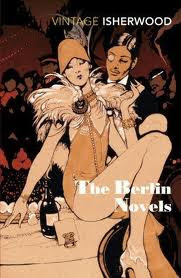 Christopher Isherwood is an English novelist who lived in Berlin as Hitler was coming to power, and these two novels capture that uncertain time. They tell the story of the various friends of one Christopher Isherwood, though he assures us that just because he has given his own name to the first person narrator “readers are certainly not entitled to assume that its pages are purely autobiographical” . Whatevs, Christopher Isherwood.