
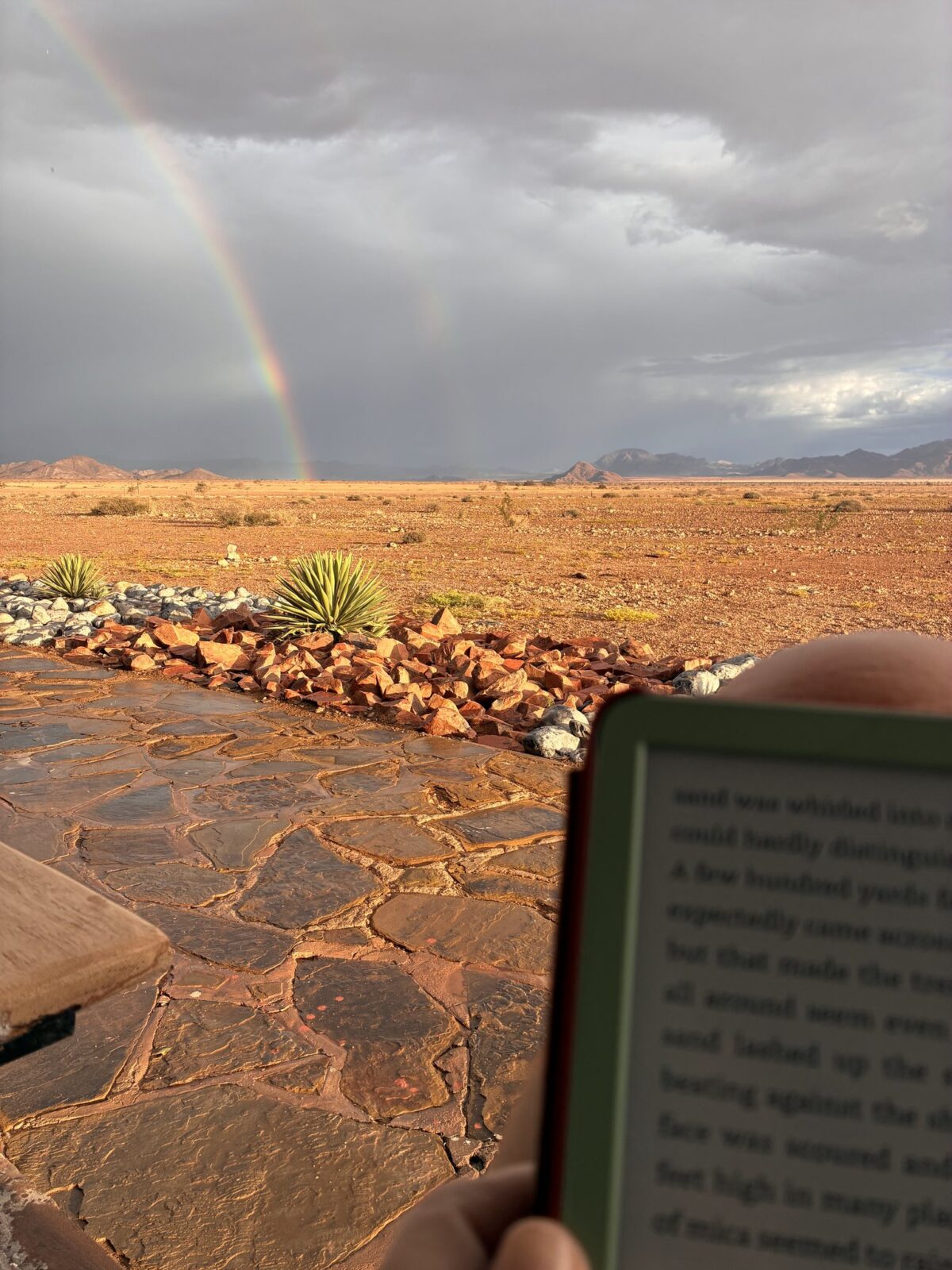
I always like to read a book from the country I’m visiting, so here is a piece of non-fiction telling about the author’s two years he spent hiding in the Namib desert 1940-1941. He went with a friend/lover(?). He claims the goal was to avoid internment by the Namibian authorities as an enemy national (as they were Germans) but I have the strong suspicion they also thought it would be kind of baller.
They drive out in a truck, and have some supplies, so at the beginning it was easy. They did have to give up their rifles to the police when war began, and came to regret this a lot, as apparently it is very difficult to shoot something at a distance with a handgun. There first Christmas was pretty good, but here is their second:
“We allowed ourselves a double portion of maize, and we made it tastier with a teaspoonful of sugar that we managed to shake out of the fabric of our long-empty sugar sack. And then we heated all our empty dripping tins and collected about two teaspoonfuls of fat. It was rancid, but to us, who had eaten nothing but fatless zebra meat for a couple of weeks, it tasted wonderful.”
And he’s underselling the zebra part. One time they are so hungry that after they manage to shoot it they don’t even wait to cook it and just eat some raw.
They do have a wireless, and so are able to listen to classical music, and to the progress of this “lunatic war,’ as he called it. Apparently they had left Germany for Namibia in the late thirties, even before war broke out, as they could see it coming and wanted no part of it. I find this cool. Talk about just opting out, even if it ends in raw zebra.
Some of the book I skipped, I have to admit, as it was long discussions between him and his friend on various philosophical topics. I recall this from another African book, LONG WALK TO FREEDOM. Clearly desert and prison are not too different and you don’t have much to do other than philosophize.
Eventually his friend gets beri-beri, so they have to go and hand themselves in. They are fined but not interned (after all that!). He ends the book with a rather sad coda, telling how his friend died in a car accident. Wikipedia tells me he was an alcoholic who suffered from depression who likely drove himself off a bridge intentionally. Also very sadly, he reflects on how much less wildlife there already is, ten years later. He notes: “no man will ever again see a head of four thousand springboks in the neighbourhood’. I had wondered about this myself; driving through the Namib I did not see anything like this. It’s sad how an apparently wild environment is already so degraded by us. Of course if we enter WW3, as we seem on course to do, maybe they will have a rebound